
Catholic Values Trust & Income Trust update – September Quarter 2026
In this September 2026 quarterly update, Portfolio Manager David Chen discusses the performance of the Catholic Values Trust and Income Trust, key market developments and how both Trusts are positioned to navigate changing market conditions while remaining aligned with Catholic values.
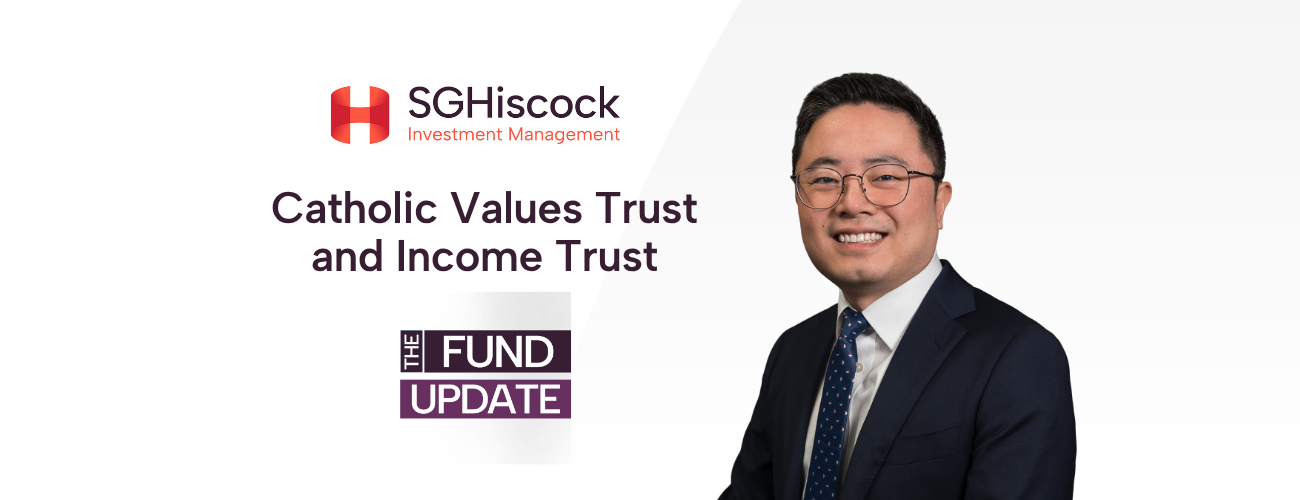
In this Catholic Values Trust and Income Trust September 2026 quarterly update, David discusses the impact of rising interest rates, geopolitical tensions and market volatility on investment markets and Trust performance. He also provides insights into portfolio positioning, the importance of active management and how both Trusts continue to balance investment objectives with Catholic values.
Watch/Listen to the Catholic Values Trust update and Income Trust update ⏬
Transcript:
September quarter performance
So, in the quarter to 30 September, the Catholic Values Trust returned 0.13% net of fees. The Income Trust returned 0.65% net. After last quarter’s strong result, this was much more subdued, as a sharp rise in geopolitical risk made markets more cautious.
The calm we saw in June didn’t last. Tensions in the Middle East flared up again. Shipping through the Strait of Hormuz was disrupted, and oil jumped more than 30% over the quarter to around $90 a barrel. And that put inflation back at the front of everyone’s mind, and the RBA responded. On 29 September, it lifted cash rates by 25 basis points to 4.6%, its fourth rise this year.
Bond markets had moved well before that, though. The Australian ten-year yield went from about 4.8% to 5.35%, and the three-year from 4.4% to 4.9%. Bond prices fall when yields rise, and the AusBond Composite market lost 1.5% for the quarter.
Equities felt it too, and higher yields hurt in two ways. First, valuations. When you can earn more on bonds and cash, a share’s future earnings are worth less today, so investors pay less for it. Second, sentiment. With safer options paying more, investors became more cautious about holding riskier assets.
The ASX 200 returned just 1.3%, and it fell 2.4% in September alone. Under the surface, it was a story of winners and losers. Healthcare was the standout, rebounding sharply off a low base. Valuations looked attractive against history, and as investors turned more cautious, the sector’s defensive qualities helped.
Energy came next, helped by high oil prices, followed by copper and gold miners within the materials sector. The losers were the sectors most sensitive to interest rates and household spending. A-REITs, which had led in June, were down 8.4%, while consumer discretionary and technology fell between 8 and 12%. Offshore global equity still posted a 1.5% gain, and the Magnificent Seven were a bright spot, with the group’s average stock up over 11%.
Japan and parts of Europe were weaker, held back by the same high oil prices and rising bond yields. That was the backdrop for the Catholic Values Trust. Rising yields, higher oil prices made it hard for most asset classes to make headway, and the result was a flat quarter.
For the Income Trust, the floating rate part of the portfolio did its job. Floating rate credit was one of the few areas to deliver a positive return, up about 1.2% across the market. And the Trust finished in positive territory at 0.65%, well ahead of the broader bond index. Credit spreads did widen a touch, with the iTraxx moving about 2 to 3 basis points to 72.
But the focus on high quality floating rate exposure and limited duration protected us from the worst of the bond sell-off.
Current portfolio positioning
Positioning hasn’t changed this quarter, and we’re comfortable with that. We’re still mildly defensive overall. In the Catholic Values Trust, that means a modest underweight to Australian equities.
We’re neutral on global equities and property, with a modest overweight to fixed income to increase the portfolio’s defensiveness, and we’re still selective on credit quality. The Income Trust takes the same approach. High-quality credit, a floating rate focus, and limited duration, and that’s what kept the trust positive through the quarter when most bonds went backwards.
Why should investors consider the Catholic Values Trust and Income Trust right now?
- Income. After the recent bond sell-off, yields are higher than they’ve been in many years. That’s a better starting point for income than we’ve had in a few months, and the Income Trust is built to capture it.
- Catholic Values. Both Trusts are managed in accordance with the Catholic Values Policy, which excludes certain sectors and companies from the portfolios. The Catholic Values Advisory Board provides independent oversight of that process.
- Active management. We actively manage both Trusts and adjust the portfolios as conditions change. This quarter clearly showed how quickly the market environment can shift and why a considered, flexible approach matters..
*The text has been edited for clarity.
Disclaimer:
This trust update has been prepared by SG Hiscock & Company trading as SGHiscock Investment Management (SGHiscock) to provide general information only and is not intended to take the place of professional advice. It does not take into account the investment objectives, financial situation or particular needs of any particular person.
Equity Trustees is the responsible entity for the Catholic Values Trust and Income Trust. Neither SGHiscock, Equity Trustees nor any of its related parties provide any warranty of accuracy. Past performance should not be taken as an indicator of future performance. You should obtain a copy of the Information Memorandum before making a decision about whether to invest in this product. Follow the link for the full disclaimer: https://sghiscock.com.au/podcast-disclosures-and-disclaimers/.

SG Hiscock & Company, trading as SGHiscock Investment Management (SGHiscock) has prepared this article for general information purposes only. It does not contain investment recommendations nor provide investment advice. Neither SGHiscock nor its related entities, directors or officers guarantee the performance of the Funds. SGHiscock also doesn’t guarantee the repayment of capital or income invested in the Funds. Past performance is not necessarily indicative of future performance. Professional investment advice can help you determine your risk tolerance as well as your need to attain a particular return on your investment. We strongly encourage you to obtain detailed professional advice. We recommend that you read the relevant Product Disclosure Statement and Target Market Determination, if appropriate, in full before making an investment decision. SGHiscock publishes information on this platform that is, to the best of its knowledge, current at the time of publication. It is not liable for any direct or indirect losses attributable to omissions, outdated, inaccurate, incomplete or deficient information. Investors and their advisers should make their own enquiries before making investment decisions.
Stay in the loop
Get the latest insights and company news direct to your inbox.