
PRI in Person October 2026: five takeaways from Amsterdam.
SGHiscock Investment Management’s CEO & Executive Chairman joined the PRI in Person October 2026:. He discusses his five takeaways from Amsterdam.
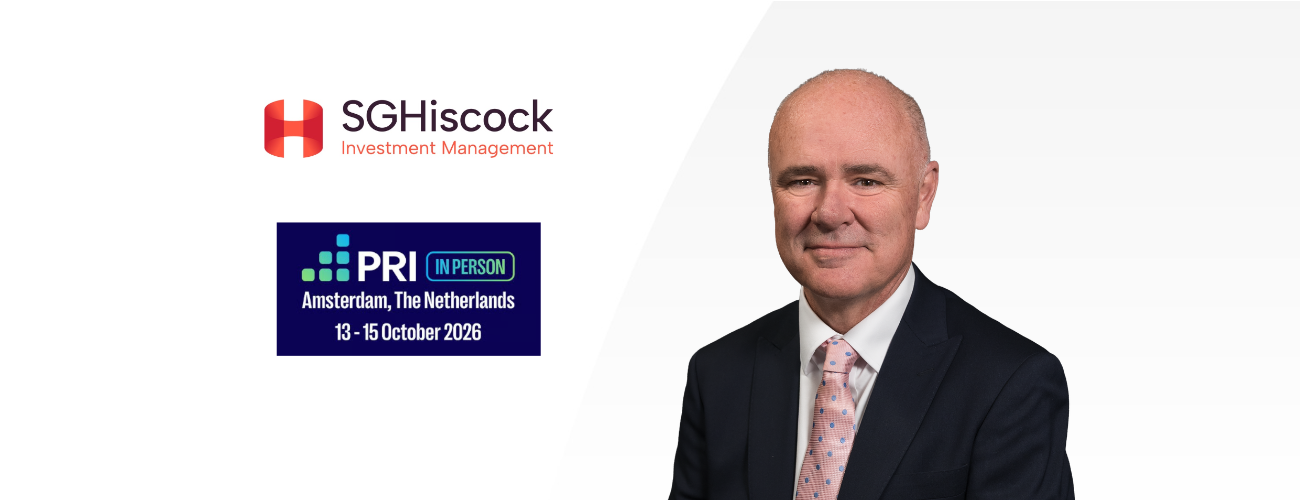
Steve Hiscock was fortunate to join more than 1,500 attendees at PRI in Person 2026 in Amsterdam recently. As a PRI signatory, SGHiscock Investment Management is committed to integrating environmental, social and governance (ESG) factors into the investment decision process.
A theme that stood out: panellists reinforced that ESG is not necessarily a standalone alpha factor. It’s an essential discipline for managing risk and protecting long-term value. This is consistent with the PRI’s long-held view that ESG factors are financially material to long-term, risk-adjusted returns. In my view, it’s a sign the industry is maturing.
Here are Steve’s five key takeaways from the conference and what he thinks they mean.
1. AI is the next systemic issue.
Common themes included large increases in power and water demand, workforce surveillance and job displacement.
Every panel session I attended referred to AI in some way. Several identified it as a serious social risk, as well as an environmental and, in some cases, a governance risk.
The TCFD framework took years to embed, and AI is moving significantly faster. Further, it was suggested that AI may now rival climate change as the greatest systemic threat.
AI and climate change are closely linked, as AI’s energy and water demands are themselves a climate issue.
2. Energy security and decarbonisation have converged.
Renewables now attract more investment than oil, and net importers such as Japan and Europe are electrifying for security reasons as much as for climate. Investors who still frame this as a choice between transition and energy are using an outdated lens.
The key questions now are grid capacity, critical minerals and who funds the infrastructure.
3. Climate risk is being repriced through insurance.
Nature risk remains underpriced, and a net zero portfolio is not automatically a resilient one.
Climate-related damage has risen significantly over the past decade, and uninsurability is becoming a real issue.
4. Regulatory fragmentation is an opportunity for disciplined investors.
The US Administration is clearly retreating in many aspects of ESG, albeit many US based investors remain strongly in favour of it. Meanwhile, standard setters such as the ISSB (International Sustainability Standards Board) and GRI (Global Reporting Initiative) are working to make their standards interoperable, while the EU’s simplified rules continue to take a broader view, covering companies’ impacts on people and the environment as well as the risks they face. The greenwashing crackdown is shrinking the “sustainable” label, and that’s healthy. Credibility now sits with process and stewardship, not fund names.
5. ESG is a risk discipline, maybe not a return promise.
The evidence points to risk reduction and capital protection, with governance still the most influential factor.
Pure alpha has been hard to achieve in recent years. Investors who integrate ESG into their investment process, rather than treating it as a separate feature, are better placed to manage those risks. SGH’s approach is to integrate ESG as a risk discipline within the investment process.
The value of attending in person?
The panels were the real value of attending. Speakers were willing to go beyond their prepared slides, and the Q&A gave everyone in the room the chance to test their thinking. Those discussions, and the conversations around them, both validated and challenged our approach as we continue to evolve our practices.
To learn more about how SGHiscock Investment Management integrates ESG into its investment process, visit our ESG page.

SG Hiscock & Company, trading as SGHiscock Investment Management (SGHiscock) has prepared this article for general information purposes only. It does not contain investment recommendations nor provide investment advice. Neither SGHiscock nor its related entities, directors or officers guarantee the performance of the Funds. SGHiscock also doesn’t guarantee the repayment of capital or income invested in the Funds. Past performance is not necessarily indicative of future performance. Professional investment advice can help you determine your risk tolerance as well as your need to attain a particular return on your investment. We strongly encourage you to obtain detailed professional advice. We recommend that you read the relevant Product Disclosure Statement and Target Market Determination, if appropriate, in full before making an investment decision. SGHiscock publishes information on this platform that is, to the best of its knowledge, current at the time of publication. It is not liable for any direct or indirect losses attributable to omissions, outdated, inaccurate, incomplete or deficient information. Investors and their advisers should make their own enquiries before making investment decisions.
Stay in the loop
Get the latest insights and company news direct to your inbox.