
CIO market update for October 2026
In this CIO market update, Rob Hogg reviews October’s key market drivers. Rob explores ongoing volatility in global bond and equity markets, rising oil prices and concerns surrounding AI-related investment. We also examine persistent inflation pressures, the RBA’s interest rate outlook and the implications for Australian equities.

In October, for the third consecutive month, some of the most significant market moves were in global bond markets. October witnessed sharp falls in global yields after sharp rises were recorded in September, so keeping bond market volatility high. Other key market trends during the month were a renewed increase in the oil price, as Middle East tensions continued, and a sharp sell-off in the US technology sector as investors increasingly questioned the potential returns from AI-related investments. Central banks maintained policy rates at unchanged levels during the month, but most banks remain biased toward further rate increases in coming months as inflation pressures remain ever present. On balance, economic growth indicators generally continued to surprise on the upside in the US and elsewhere across the globe during the month.
In Australia, however, key economic reports pointed towards progressive slowing in growth momentum with weaker reports released regarding employment, household consumption, and both consumer and corporate sentiment. Inflation remains sticky and, most concerningly, the RBA is now suggesting that they are receiving reports from companies in their liaison program that reveal that companies are upwardly revising their medium term inflation expectations (“the central banker’s nightmare”). Unfortunately for the Australian economy, the continued stickiness of inflation is likely to lead to further RBA rate hikes despite the continued signs of economic slowdown.
As noted above, following sharp increases in September, global and Australian bond yields fell in October, largely reflecting the over-sold levels (highly elevated yields) that had been reached in late September. The US 10-year yield fell by around 0.35% over the month while the Australian equivalent fell by around 0.23%. These falls occurred despite inflation reports in both countries continuing to point to elevated inflation pressures (news which would generally be expected to lead to higher market interest rates). The sharp moves up and down in yields in recent months have caused measures of bond market volatility (MOVE Index) to rise sharply to around levels last reached at the time of US President Trump’s 2025 April 2 “Liberation Day” tariffs.
Equity market performances were extremely varied in October with indexes sensitive to the US economy’s strengthening underlying growth pulse (the Dow Jones (+1.7%) and the Russell 2000 Small Caps (+0.5%) both posting gains for the month. But indexes relatively more weighted toward the Tech sector – the S&P 500 (-0.9%) and the Nasdaq (-5.3%) were weaker. Amongst the weakest US indexes for the month was the Philadelphia Semi-conductor index (SOX) which retreated very sharply (-15%). Generally, over the last few months, the broad-based S&P 500 has failed to advance, yet that obscures an enormous amount of volatility at the single stock and sector levels of the market.
Asian equity markets also tend to have relatively high Tech weightings and were similarly weak over the month with the Japanese Nikkei and Hong Kong Hang Seng both lower by around 5.3%. The South Korean market retreated -16%.
Meanwhile, the Australian equity market (ASX 300 Accumulation Index) produced a gain of around +1.1% with gains in Utilities, Banks and Healthcare outweighing losses in Tech, Gold and Materials. However, further down the market cap spectrum, performances weakened sharply with the Small Ordinaries Accumulation Index falling 6.4%.
The continued lack of progress in finding a settlement in the Middle East led to another increase in the oil price over the month (the fourth consecutive monthly increase) while copper and gold prices both fell.
Most likely boosted by the market’s increased expectation of more RBA rate hikes, the AUD strengthened slightly against the USD over the month.
Key market movements over October were as follows:
- S&P/ASX300 Accumulation Index (i.e. including dividends) rose by 1.1%
- S&P/ASX Small Ordinaries (Australian Small Companies) Accumulation Index retreated by 6.4%
- US equity market (S&P 500) fell around 0.9%
- Measures of market volatility remained elevated, especially bond market volatility (the MOVE index)
- The US bond market ended the month with the yield curve shifting lower in a near parallel fashion (yields of all maturities down by 0.30%-0.35%)
- The Australian yield curve “flattened” as yields on longer-dated securities (10-year bonds) fell by around 0.23% while shorter-dated yields (2-year notes) ended 0.09% lower – this pattern reflecting the implied increase in the market’s expectation of additional RBA rate hikes in the overall context of a retreat in yields in October from over-sold (high) levels at end September
- Driven largely by the move in RBA policy expectations toward greater than previously expected rate hikes, the AUD rose slightly against the USD to USD 0.7030 from USD 0.6950
As we have been noting in recent months, the global economy has weathered the ongoing impact of the Middle East war (primarily higher oil prices) significantly better than most investors had expected. Initial sharp falls in household and corporate sentiment/confidence surveys in March/April as the war broke out have not been followed by similarly weak economic data. In fact, it seems likely that the significant fiscal stimulus measures being enacted by a number of governments across the globe are more than fully offsetting the negative impact of higher oil prices and are contributing to an increase in economic momentum, which is positively surprising investors.
But risks emanating from the war are not over. It is still possible that a sharp deterioration in the Middle East situation could cause an extremely elevated spike in the oil price which the global economy might find more difficult to cope with. Key among these oil-related risks is an unanchoring of inflation expectations – something which may be beginning to occur in Australia – and would cause global central banks to increase interest rates more sharply than is currently expected. In the Australian context, an unanchoring of inflation expectations refers to risk that households and/or corporates no longer assume that inflation will average 2.5% (the mid-point of the RBA’s range), but will instead be higher.
The AI investment trend is another key risk whereby any significant change in expectations about the likely investment return from the current highly elevated level of AI-related capex could cause a significant downturn in related share prices – already there are signs that US earnings growth may have peaked.
Regarding the outlook for domestic financial markets, unfortunately the Australian economy is following a slightly different trajectory to most countries, driven by the pre-existence on an upward inflationary impulse which pre-dates the Middle East war and led the RBA to tighten policy on February 3 (before the war began).
We remain of the view that it has been the change in expectations about the policy outlook (from rate cut expectations in September last year to expectations of rate hikes a few months later, and then actual hikes in early 2026) that has retarded the performance of the Australian share market (particularly for domestically focussed companies) and caused local bond yields to rise.
During October, company earning updates confirmed that trading conditions for consumer and housing linked sectors have continued to decelerate as the lagged effects from tighter monetary policy and significant policy reform continue to build and negatively impact both top line earnings and margins for many listed equities.
As we’ve been noting for several months now, it will likely only be at the point in the future when the local bond market begins to “look-through” any further potential rate hikes and instead begins to focus on potential medium-term rate cuts, that this current negative sentiment could lift. Following the RBA’s latest “jawboning” (contained in speeches by key officials), it seems the RBA’s rate hike cycle is not yet over. (As evidenced by the RBA’s early November rate hike – it’s fifth for the year)
In this monthly update we look at:
- The biggest risk for equity and bond markets is unanchored inflation expectations
- How important has AI-related investment spending become to the global economy and investment markets?
- Is US company earnings growth slowing, and is this a risk to the market outlook?
- What is the RBA currently focused on in its policy tightening cycle, and what might cause the RBA to stop raising rates?
- Australian equities in a period of rising rates
- The outlook
Are inflation expectations beginning to “un-anchor”?
While trends in oil prices and AI investment spending get most of the market’s attention, probably the most important risk to the market outlook is any change in inflation expectations. This was a risk highlighted by RBA Deputy Governor Hauser in a speech in October. A change in inflation expectations (an un-anchoring) would likely lead to a more pronounced monetary policy response, with the risk that this response pushes the economy into a more serious slowdown.
Below we look at the latest trends in inflation expectations for investors, corporates and households in the US and Australia – Australian households’ inflation expectations stand-out as potentially becoming unanchored.
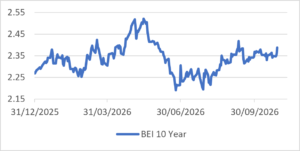
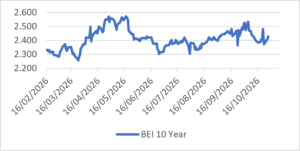
To date there are few signs that investors are changing their view about medium term inflation expectations – witness the continued stability in inflation “breakevens” (the market’s implied inflation expectations) in both the US and Australian bond markets.
US 10-year break-even inflation expectations. Calendar 2026
Source: Bloomberg, SGHiscock
Australian 10-year break-even inflation expectations. February 2026 – October 2026
Source: Bloomberg, SGHiscock
There are similarly few signs that, apart from a spike in March/April, corporates are changing their inflation expectations either.
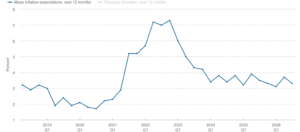
In the US, the Cleveland Federal Reserve conducts a quarterly survey of company inflation expectations (but unfortunately the latest measure is dated mid-August). Their latest survey shows few signs of any change in expectations – but perhaps the update due in November may be different. Similarly, there are few signs that Australian corporates are expecting an acceleration in price pressures. While the NAB survey showed a sharp increase at the time of the outbreak of the Middle East war, the latest NAB monthly business survey showed that while growth in purchase costs rose, there were falls in labour cost growth, final product price growth and retail price growth.
US firms’ inflation expectations over the next twelve months
Source: Federal Reserve Bank of Cleveland
Price pressures in the NAB Business Survey
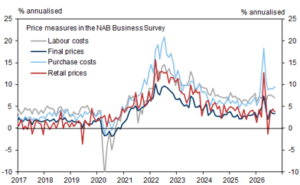
Source: Goldman Sachs, NAB Business Survey, September 2026
Are there any signs that households are beginning to re-set their inflation expectations?
The Federal Reserve Bank of New York conducts a monthly survey of US consumers’ inflation expectations. Their latest survey for September revealed that one-year forward inflation expectations increased by 0.3 percentage points (ppts) to 3.9%, the highest reading since May 2023. However, inflation expectations over longer term periods (three and five-years ahead) remain well anchored at 3.3% and 3.0%. However, in Australia the situation appears quite different with consumer inflation expectations in Australia having risen sharply in 2026. The latest four week moving average measure of two-year forward inflation expectations (as at October 27) showed an increase to 6.1% p.a.. This is one of the most important reasons why the RBA’s rate hiking cycle may not be over.
New York Fed survey of one-year ahead inflation expectations
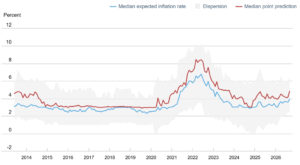
Source: New York Fed Survey of Consumer Expectations
ANZ Roy Morgan two year ahead Inflation expectations
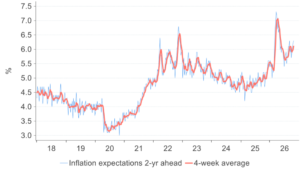
Source: ANZ Roy Morgan
How important has AI-related investment become to the global economy and investment markets?
US (and global) economic growth has become increasingly dependent on increased investment in the infrastructure that enables Artificial Intelligence (AI). AI-related investment has accounted for a significant share of US GDP growth over the last two years (now totalling 10.5% of GDP), meaning that the US economy’s growth outlook is highly dependent on whether this investment continues to occur at such a pace.
AI has become a substantial contributor to US GDP growth
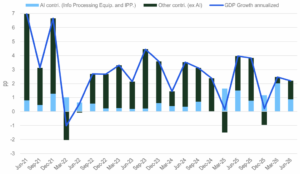
Source: Citi, US Bureau of Economic Analysis
The key downside risk to US GDP growth and AI-related equity and corporate bond market pricing is that, at some point, concerns about the return from investing in AI infrastructure (relative to the cost of funding the investment) would cause currently surging AI investment to slow or even decline.
If the market begins to expect AI-related spending will slow (and we may have seen hints of this October), we can expect to see that change in sentiment leading to downward pressure on the prices of AI-related shares and corporate bonds, and downward pressure on government bond yields (as investors seek safe-havens). Market expectations for future US official interest rates would also likely be revised lower (than would otherwise be the case) in such a situation.
Is US company earnings growth slowing, and is this a risk to the market outlook?
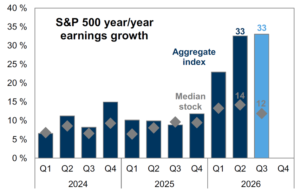
Related to the robust pace of AI-related investment has been the surprisingly robust pace of growth in US corporate earnings in 2026, one of the key surprises this year. But, while earnings growth is historically strong, there are increasing signs that the peak in earnings growth momentum may have been reached.
According to analysts at Goldman Sachs (GS), with 60% of S&P 500 companies having reported their Third Quarter earnings (as at the end of October), S&P 500 EPS growth is on track to register 33% year/year growth in Q3. This would match Q2 as the strongest quarter in recent decades outside of post-recession recoveries. However, it would also mark an end to the pattern of acceleration in annual growth that has characterised the last few quarters.
Highlighting how historically strong earnings growth currently is, the 33% growth rate in Q3 compares with a 10-year median growth pace of 10%. Similarly surprising is the fact that annual earnings growth for the median S&P 500 stock is tracking at 12%, well above the 10-year median of 8%, but a deceleration from the 14% growth rate last quarter.
S&P 500 Q3 2026 EPS growth
Source: Goldman Sachs
Also showing signs of slowing are analyst estimates of AI investment spending growth, in contrast with the pattern of upward revisions in recent quarters. Reflecting the likely deceleration in AI capex growth, analyst estimates show earnings growth for S&P 500 AI infrastructure stocks peaking at 80% this quarter and slowing to roughly 40% in 2026. As these growth estimates slow there is a risk that the forward P/E multiples currently being applied to many of these AI related companies begin to slip, so compounding the potential negative impact on related stock prices.
In total, the earnings upside that has driven the US equity market so far this year is showing signs of moderating as analyst earnings estimate revisions have been less strong in the current quarter compared with the previous two quarters as earnings revision breadth has moderated.
What is the RBA currently focused on in its tightening cycle?
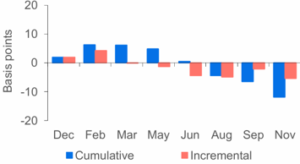
With an additional tightening move at the end of September, the RBA had raised rates by 1.00% in calendar 2026, in four 0.25% increments. As at the date of writing, market expectations are for an additional single increase of 0.25% by the time of the February 27, 2027, RBA policy board meeting. (In fact, the RBA raised rates at its early November meeting).
The key issues about which the RBA is currently most concerned in determining its monetary policy steps were highlighted in a speech in October by RBA Deputy Governor, Andrew Hauser.
Hauser noted that the RBA has, since August, been identifying three upside inflation risks:
- A prolonged Middle East crisis,
- The burgeoning AI and tech boom; and
- The possibility of even weaker domestic supply constraints.
Hauser added that the fact that inflation’s been high for a “very long time now” is also a factor.
Importantly in his speech, Hauser suggested that each of these above risks identified in August seem to be even greater now:
- On the Middle East, oil prices are even higher now than assumed in August,
- On AI, we’re seeing higher AI prices, with tech prices and the data centre building boom feeding through into CPI; and
- On domestic capacity pressures, components of the CPI that are rising the most (like market services) are actually the ones most directly linked to capacity pressures.
Hauser added another newer (detrimental) factor impacting RBA deliberations was that the RBA’s surveys of businesses were now finding that there is an increasing share of businesses who are thinking that maybe 3% to 3.5% is the new normal for inflation – “the central banker’s nightmare” – and not 2.5%, the mid-point of the RBA’s target range.
In sum, Hauser highlighted that “the inflation outlook has deteriorated” since August.
Together, all these factors suggested that the RBA’s tightening process was not yet finished – as evidenced by the early November hike. Following the November 3 hike, market pricing now suggests the RBA’s job is done, with a higher probability of rate cuts (than hikes) seen by the market over the coming year.
Expected change in the Australian cash rate (compared with the current 4.85% rate)
Source: ANZ, Bloomberg
What might cause the RBA to end its policy tightening cycle?
The most likely potential catalyst for the RBA to consider finishing its tightening cycle would be a marked slowdown in the economy that, in turn, would be expected to sharply cool inflationary pressures and inflation expectations. For clues to this possibility, we look to key sentiment measures of both the household and business sectors, both of which have weakened sharply in recent months.
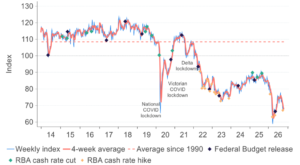
As measured by ANZ-Roy Morgan, consumer confidence (in the week ending October 25) remained historically weak. But (underlying the RBA’s developing policy dilemma), on a four-week moving average basis the confidence survey found that weekly inflation expectations lifted to their highest level since May, echoing Deputy Governor Hauser’s remarks about inflation expectations increasing in the RBA’s “liaison program”.
ANZ-Roy Morgan Consumer Confidence Index
Source: ANZ Roy Morgan
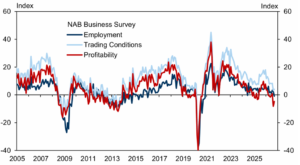
Business confidence has also been weak in recent months with business conditions (as measured by the NAB survey) in September remaining around the lowest level since August 2020.
Details of the latest report were generally soft, with the employment sub-component falling to its lowest level since November 2020.
While sentiment indexes such as the ANZ/Roy Morgan and NAB surveys can sometimes give completely misleading signals as to the future performance of the real economy, it is clear that survey respondents are experiencing their most downbeat sentiment in many years that may, or may not, translate into weaker activity.
NAB Business Conditions survey (September)
Source: NAB, Goldman Sachs
Australian equities in a period of rising rates
We have been noting for a number of months that the swing in RBA rate expectations over the past year has been extremely negative for Australian equity market sentiment and bond market pricing. The initial impact of the tightening cycle was on sentiment measures (household and consumer) which have now reached multi-year lows. But weaker sentiment doesn’t always lead to weaker economic growth and earnings.
However, we are now Increasingly seeing the impact of the near year-long tightening cycle on actual earnings prospects. Morgan Stanley analysts note that in the second half of October, company earnings updates have confirmed that trading conditions for consumer and housing linked sectors have continued to decelerate as the lagged effects from tighter monetary policy and significant policy reform continue to build and bite into both top line earnings and margins for many listed equities. They highlight that the broad narrative from company management is one of a consumer seeking value, with promotional activity high. At the same time, cost pressure remains elevated – a less than ideal background for company earnings.
Macquarie analysts are noting similarly that, in a complete contrast to this time last year, where companies are surprising the market, it has tended to be more negative than positive. They also highlight consumer weakness, increasingly concentrated in discretionary spending while essential spending remains more resilient. Presently the most negative surprises are coming from the Consumer Discretionary, Transport and Media sectors. RBA hikes and high energy costs appear to be the key causes of the weakening earnings outlook.
Outlook
The global economy has been less negatively impacted by the Middle East war than had been initially feared. But the renewed rise in the oil price, as the Middle East peace has evaporated, is cause for continued caution. But it seems that the trend across most of the globe is one of upside growth surprise.
The market outlook in Australia is more problematic than many other countries given the RBA’s current policy tightening cycle, with more rate hikes possible. It’s difficult to see sentiment about Australian-sourced company earnings and the Australian economy improving until expectations about the RBA’s next policy move switch to expected rate cuts.
While additional rate hikes run the risk of hiking into a slowdown, it might be a mistake to regard the outlook for the local market as being negative over the medium/longer term – the local market’s recent underperformance relative to global markets (in local currency terms) owes much to local monetary policy changes in our view.
We remain slightly underweight Australian Equities, but we are closely monitoring the market for a change in these interest rate policy expectations. The broadening trend of economic weakness could well reduce the RBA’s need to raise rates again and even bring forward prospects for a rate cut. Markets will move well ahead of any actual rate cut and a change in rate expectations could swing sentiment significantly.
Given the magnitude of underperformance of Australian Equities vs Global in local currency terms (especially US) equities, the likelihood of mean reversion is increasing, but we are also cognisant that part of the US outperformance has been driven by superior earnings growth and not valuation expansion, and that aspect of the US outperformance is therefore justified. For Australian equities to begin a sustained period of outperformance, earnings prospects need to begin a period of improvement outstripping other global markets.

SG Hiscock & Company, trading as SGHiscock Investment Management (SGHiscock) has prepared this article for general information purposes only. It does not contain investment recommendations nor provide investment advice. Neither SGHiscock nor its related entities, directors or officers guarantee the performance of the Funds. SGHiscock also doesn’t guarantee the repayment of capital or income invested in the Funds. Past performance is not necessarily indicative of future performance. Professional investment advice can help you determine your risk tolerance as well as your need to attain a particular return on your investment. We strongly encourage you to obtain detailed professional advice. We recommend that you read the relevant Product Disclosure Statement and Target Market Determination, if appropriate, in full before making an investment decision. SGHiscock publishes information on this platform that is, to the best of its knowledge, current at the time of publication. It is not liable for any direct or indirect losses attributable to omissions, outdated, inaccurate, incomplete or deficient information. Investors and their advisers should make their own enquiries before making investment decisions.
Stay in the loop
Get the latest insights and company news direct to your inbox.