


Catholic Values Trust & Income Trust update – March Quarter 2026
Catholic Values Trust & Income Trust update: March Quarter 2026 In this update, David Chen, Portfolio Manager of both the Catholic Values Trust and Income Trust, outlines how rising inflation, interest rates and geopolitical tensions drove market volatility, highlighting the benefits of a defensive, actively managed and Catholic values-based investment approach. Watch/Listen to the Catholic…
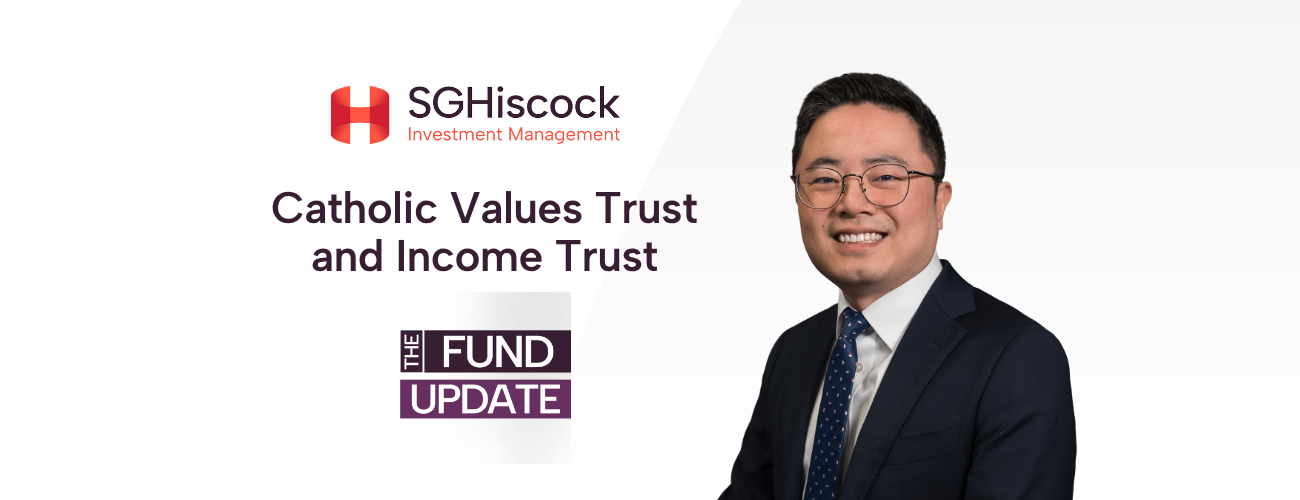
Catholic Values Trust & Income Trust update: March Quarter 2026
In this update, David Chen, Portfolio Manager of both the Catholic Values Trust and Income Trust, outlines how rising inflation, interest rates and geopolitical tensions drove market volatility, highlighting the benefits of a defensive, actively managed and Catholic values-based investment approach.
Watch/Listen to the Catholic Values Trust update and Income Trust update ⏬
Transcript:
March quarter performance
Over the quarter to 31 March, the Catholic Values Trust returned -3.24 %, while the Income Trust held up better, finishing up 0.68%. It was really a tale of two halves. The quarter started strongly, then shifted abruptly into a more defensive environment as geopolitical tensions escalated.
Through January and February, markets were in good shape. Equities were pushing higher, supported by solid earnings, a resilient labour market, and rising commodity prices. We also saw a shift in where investors were allocating capital; software stocks came under pressure as investors questioned their ability to keep up with rapid advancements in AI.
Money moved out of higher-growth names and into more traditional, asset-heavy businesses, which supported the Australian market, particularly materials. But that positive momentum didn’t last as the quarter progressed; inflation reemerged as a concern. Data came in stronger than expected, and price pressures broadened across the economy.
In response, the RBA raised rates in both February and March to stay ahead of rising inflation expectations, which pushed bond yields higher, particularly at the front end. At the same time, credit spreads widened slightly, reflecting a more cautious outlook.
The key turning point came late in the quarter, when military action involving the US and Israel targeting Iran led to a sharp escalation in the region and the Strait of Hormuz, a critical route for global oil supply, was effectively closed. Oil prices surged above 120 USD a barrel, adding further inflation pressure at a time when central banks were already on edge. That changed the outlook quite quickly.
Interest rate expectations moved higher, and investors became more defensive, reducing exposure to risk assets. There were also real economic impacts, with fuel supply disruptions and early signs of rationing in some regions. Consumer confidence fell as higher petrol prices put additional pressure on household budgets.
Overall, it was a weaker quarter; markets came in with fairly optimistic expectations, but those expectations shifted quickly. Inflation remained stubborn. The oil shock added further pressure, and investors had to adjust to a backdrop of higher interest rates and greater uncertainty. Against that backdrop, the portfolio’s defensive positioning helped, with lower exposure to risk assets cushioning some of the downside. Interest rate-sensitive sectors were hit the hardest, with Australian REITs and technology the main detractors. Materials, consumer staples and utilities held up better, while energy was a standout, benefiting from higher oil prices.
Current portfolio positioning
We’re continuing to maintain a more defensive stance across the portfolios. Equities remain underweight. There’s still uncertainty around inflation. The impact of recent rate hikes and higher oil prices on consumer demand and broader global growth risks, particularly in the Middle East. While some areas have become more reasonably valued, others still look stretched, especially large-cap financials and parts of the technology sector.
On the fixed income side, we remain overweight. Yields have moved higher, and our pricing in a more challenging inflation backdrop, including the impact of high energy prices and further rate increases, has brought valuations back closer to fair value and to levels we haven’t seen in quite some time, improving the attractiveness of the asset class.
Why should investors consider the Catholic Values Trust and Income Trust right now?
There are three key reasons we think both funds remain attractive.
First, strong and consistent income. The Income Trust continues to deliver reliable returns above term deposits and cash. It provides steady income through a diversified mix of fixed income and hybrid securities.
Second, our values-based approach. We invest with a clear framework aligned to Catholic values, avoiding certain sectors, and focusing on responsible businesses. This is supported by independent oversight from the Catholic Values Advisory Board.
And third is how we manage the portfolios. They’re actively managed and well diversified, not a set-and-forget approach. We are just positioning as conditions change, allowing us to stay defensive when needed, while remaining ready to take advantage of opportunities. That flexibility is especially important in today’s volatile and uncertain environment.
Click HERE to find out more about the trusts. Follow us on LinkedIn.
*The text has been edited for clarity.
Disclaimer:
This trust update has been prepared by SG Hiscock & Company (SGH) to provide general information only and is not intended to take the place of professional advice. It does not take into account the investment objectives, financial situation or particular needs of any particular person.
Equity Trustees is the responsible entity for the Catholic Values Trust and Income Trust. Neither SGH, Equity Trustees nor any of its related parties provide any warranty of accuracy. Past performance should not be taken as an indicator of future performance. You should obtain a copy of the Information Memorandum before making a decision about whether to invest in this product. Follow the link for the full disclaimer: https://sghiscock.com.au/podcast-disclosures-and-disclaimers/.

SG Hiscock & Company, trading as SGHiscock Investment Management (SGHiscock) has prepared this article for general information purposes only. It does not contain investment recommendations nor provide investment advice. Neither SGHiscock nor its related entities, directors or officers guarantee the performance of the Funds. SGHiscock also doesn’t guarantee the repayment of capital or income invested in the Funds. Past performance is not necessarily indicative of future performance. Professional investment advice can help you determine your risk tolerance as well as your need to attain a particular return on your investment. We strongly encourage you to obtain detailed professional advice. We recommend that you read the relevant Product Disclosure Statement and Target Market Determination, if appropriate, in full before making an investment decision. SGHiscock publishes information on this platform that is, to the best of its knowledge, current at the time of publication. It is not liable for any direct or indirect losses attributable to omissions, outdated, inaccurate, incomplete or deficient information. Investors and their advisers should make their own enquiries before making investment decisions.
Stay in the loop
Get the latest insights and company news direct to your inbox.