

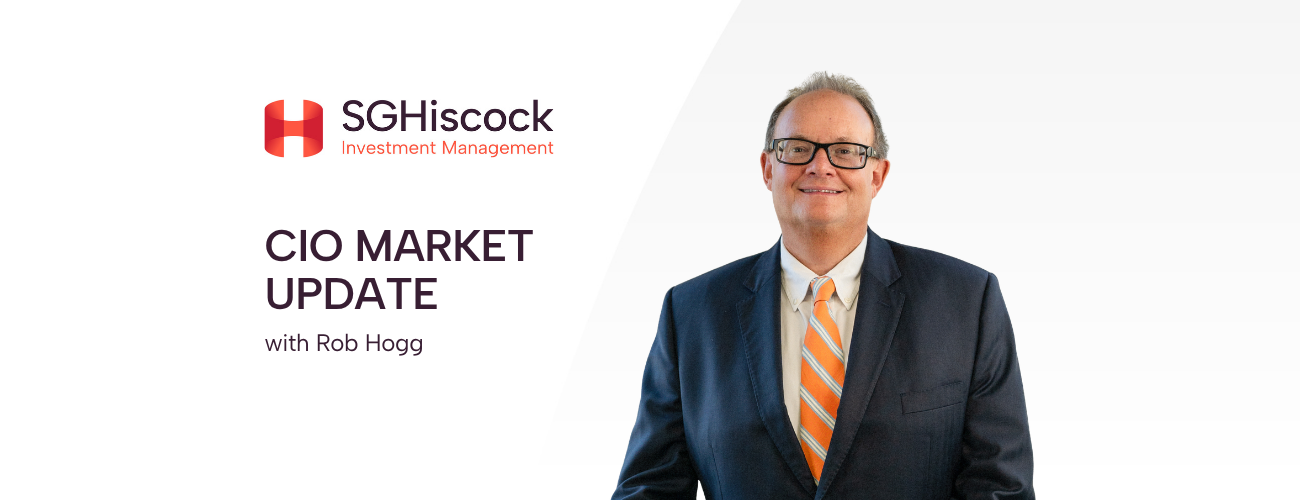
November 2025: AI, Stablecoins & Small Companies
In episode #18 of The Active Investor with SGH – December 2025: AI, Stablecoins & Small Companies – In this episode of The Active Investor with SGH, Steve Hiscock and Rob Hogg break reviews market activity, noting that volatility was driven mainly by shifting expectations around US interest-rate cuts, while concerns about an AI-driven tech…

In episode #18 of The Active Investor with SGH – December 2025: AI, Stablecoins & Small Companies – In this episode of The Active Investor with SGH, Steve Hiscock and Rob Hogg break reviews market activity, noting that volatility was driven mainly by shifting expectations around US interest-rate cuts, while concerns about an AI-driven tech bubble persist but appear premature. They also discuss Klarna’s upcoming USD-backed stablecoin and the growing role of stablecoins in payments.
In Australia, inflation has broadened, reducing the likelihood of rate cuts and weighing on equity markets.
In this episode, Steve Hiscock is joined by Rory Hunter, Co – Portfolio Manager of the SGH Australian Small Companies Fund, explains that small-cap stocks—especially in resources such as gold and critical minerals—have driven strong fund performance. He sees potential for a multi-year resources cycle supported by AI-related demand and energy transition trends and warns that rising rates could pressure small industrials.
More places to find our podcast:
November 2025: AI, Stablecoins & Small Companies
Transcript
Steve Hiscock:
Hello to everyone listening to our podcast, the Active Investor with SGH. I’m Steve Hiscock, the chair of the company, and it is my pleasure to be your host for today’s episode. In today’s podcast, we’ll be looking at what happened over November, 2025, discussing the outlook going forward, and we have a special guest joining us, Rory Hunter, who’s the head of our small companies area. He’s going to be talking about small companies and how they’ve been going.
This podcast is being recorded on Friday, the 28th of November, 2025. And joining me again today to start with is our Chief Investment officer, Rob Hogg. Hi Rob. How are you?
Rob Hogg:
Steve. I’m very well.
Steve Hiscock:
Excellent. So, I’m looking at the month, Rob. It was a bit up and down, wasn’t it? What were the key themes coming out of the market?
Rob Hogg:
We’ve still got the ongoing theme of AI and people worrying that we might be in the midst or maybe at the beginning, perhaps, of a new AI related tech sort of bubble, so that continues to permeate the market, but really the overwhelming influence in terms of affecting within the month performances and trends was all the ongoing debate about the US Central Bank.
Will they cut rates in December? Or not, or what? And it was really that as sentiment moved around and waived on the likelihood of them cutting rates in December, that’s really what drove the pattern that we saw in the month.
Steve Hiscock:
Okay, so you mentioned tech. Are we in a tech bubble?
Rob Hogg:
Look, there are some signs that you would perhaps see at the beginning of a bubble. And look, probably the first-round sign there is the fact that we’ve seen significant price increases in a lot of the companies that are most closely associated with the whole AI story. So that’s the magnificent seven as generally expressed, but also a range of other companies that have businesses allied to AI.
But that’s just the first-round effect. And that in and of itself is not enough to make a bubble. To have a bubble of the magnitude that we had back in 1999, so the tech bubble, the NASDAQ bubble, you need to see the euphoria, if you like, about the new technology drive an incredible increase in investment spending. You need to see that incredible increase in investment spending start to affect balance sheets. And in fact, you need to see a bit of an erosion of corporate financial balances.
Generally, that would be associated with the beginnings of an increase in credit spreads. And that’s associated with an increased leverage across the corporate sector. And as well, you need to see reflecting the huge boom in investment you need to see, really, the overall current account deficit of the US starts to really deteriorate.
And look, we haven’t yet got to the point that we did in the period going into 1999 into 2000 in regard to those criteria, whether it’s current account deficit, whether it’s balance sheet health, whether it’s leverage or whether indeed it’s credit spreads. But we do see to be getting some of the very, very beginnings.
I think one of the encouraging things is that there are a lot of people talking about, are we in a bubble? If no one was talking about a bubble, and we are all just purely euphoric, that is more likely to be a bubble. So perhaps we’re in the foothills and perhaps we will get a full blown bubble.
But at this point in time, we don’t have all of the criteria that you’d normally see. I’ve seen some very interesting work during the course of the month actually by UBS, and they’ve looked at something, a technique they called Similarity Analysis, and what this involves is looking at patterns within markets for equities, equity sectors, interest rates, credit spreads, currencies, and so on.
Trying to work out what period of time is most similar to the current dynamics that we see in markets and they, in doing this work, have said that the most similar time to now is in fact March, 1998. So that that’s another and very interesting way of thinking about it apart from what I was talking about before, the sort of fundamentals of indebtedness and leverage and current accounts and borrowings and so on.
Another way is to use this similarity analysis. And that would suggest in the foothills. But of course the NASDAQ bubble peaked some two years later than March, 1998.
Steve Hiscock:
Okay, so I guess the summary is that we are not so overvalued that there’s likely to be a crash. It might even go further up.
Rob Hogg:
I think, as we’ve said, we’re very likely to get corrections. And we’ve had periods of weakness in the month. That’s perhaps somewhat AI and valuation related, but I think it’s more related to monetary policy expectations and how accommodative the Fed may or may not be, or may not be allowed to be, given the inflation constraint.
Steve Hiscock:
Thank you for that. So, another thing that happened was another stablecoin was launched, or is yet to be, is as soon as be launched, right?
Rob Hogg:
In the process of being launched. So Klarna, the Swedish Buy Now pay later firm, they’re launching a payment stablecoin, Klarna USD, using the blockchain technology.
Now just as a reminder, stablecoins are a form of privately issued digital coins backed by usually short-term securities or cash-like assets. And as these new payment forms have advanced, they’ve generally been linked to US dollars. So they are completely different to cryptocurrencies like Bitcoin, which don’t have any asset backing at all.
Stablecoins do have asset backing. So just interesting that we’ve had yet another well-known global brand launch their own stable coin. So they Klarna expect the digital token, so the stablecoin to be used for international payments, probably internally at first, but then for merchants and eventually for consumer payments.
And they expect that’ll dramatically reduce costs for consumers and merchants. So again, this theme of international payments, cross-border payments, that’s where we’re likely to see these types of payment forms most significantly used earlier on. So just in terms of how much there is in dollar value in these stablecoins.
The Financial Times site data from Citigroup suggesting that presently there’s 280 billion of stable coins in issuance. That’s as at the end of September, and that’s up from 200 billion. So now 280 was 200 billion at the start of 2024. So these things are gaining more and more. Momentum, traction.
Yeah. And will be more and more significant, but again, they’re not, they are not Bitcoin, things like that.
Steve Hiscock:
They’re not in the same asset class, really, are they? So stablecoins, some of them pay interest, but most of them don’t.
Rob Hogg:
Most of them don’t because that’s the value to the issuer.
They pick up the interest return on the underlying securities. So, this is what the Genius Act was all about in the United States. The Genius Act was all about setting up the infrastructure, the regulatory infrastructure, for stable coins. But they are developing very swiftly as a different but significant form of payment.
Steve Hiscock:
Thank you. So just moving on to interest rates, it’s a big thing, right? We, there’s been some big changes in the US but more so in Australia. I think that we’ve really done almost 180 degrees, haven’t we?
Rob Hogg:
Yeah. In the last couple of months, the market expectations have gone from expecting several rate cuts in 2026 to just at the margin, tending toward a rate increase. And look, this is all about the inflation story, in Australia. The last several monthly and quarterly reports have surprised on the upside, but it’s not just surprising on the upside, it’s the breadth of the upside surprise across so many areas mainly of services.
So, we’ve seen this now over the last, at least two, maybe three months. And it, it almost looks like inflation is gaining momentum. It’s certainly broadening in terms of the proportion of the CPI basket, as it’s described, it’s now showing an increase, an acceleration in upward price pressure.
So, this of course, makes it incredibly difficult for the Reserve Bank to cut rates, and this is occurring as well in a back against the background that the economy is showing some signs of picking up. It’s a very gentle pickup in terms of consumer spending and corporate sentiment. But interestingly enough, we got some data during the month that pointed to investment spending in Australia. And we hear an awful lot of course about AI related CapEx in the US. This report for September quarter CapEx here in Australia showed that Australia itself is starting to experience its own data center CapEx boom with spending in the information media and telco industry up by a lazy 90% in the September quarter.
So, we are starting to see the impact here as well. So that will be an impetus to growth. So for the RBA, it’s tricky. The economy’s picking up a little bit. I think, we’ll probably see a little bit of a wavering with consumer sentiment and maybe even housing sector sentiment as the realization of no more rate cuts seeps in. But look, broadly speaking, the RBA’s hands are tied at this point due to the inflation story, which is mainly a domestically driven story.
Steve Hiscock:
Yes, that’s right. But the market hasn’t really gone, it hasn’t really negatively..
Rob Hogg:
It hasn’t really gone up for a couple of months, really. The Aussie equity market is one of the worst performing markets. This is just in price terms. Total return terms. It’s a little bit better, but it’s still laggard. But it’s really plateaued and found it difficult to move significantly ahead really, for the last two or three months, and that’s happened at the same time that the monetary policy expectation scenario has changed.
So, I think that’s been one of the key influences here that of any country in the world, our short-term policy expectations have changed really the most, right? Negatively, as far as equity markets are concerned. And I think that’s really what’s been holding us, well one of the key factors holding us back in the last several months.
Steve Hiscock:
But interestingly, and we’ll get onto this with Rory joining us, small companies have continued on despite the large companies going sideways, right?
Rob Hogg:
Yeah, they have, there’s been a big rotation in terms of performance that I’m sure Rory will talk about. So some areas of the market that were really excited and invigorated by rate cut talk have now some of them have really come back to earth as the rate cut talk has changed.
And look, perhaps we’re now at the point where the pessimism about rate cuts has probably gone perhaps too far. But we will have to see at the moment. There’s really no rate cut scene anytime soon here in Australia.
Steve Hiscock:
Alright, Rob, thank you very much. So, my next guest is Rory Hunter, who runs our small companies division. Rory joined us in 2018 and heads up our small companies unit, and we thought it would be really good today because small companies have been on a run. They underperformed for a few years against the large caps, and they’ve really come into their own in the past 12 months.
So Rory, your team runs the small company unit trust at SGH. I’m a little bit proud here, but the performance of the funds over the past 12 months has been absolutely terrific. You’ve got three different funds in various spectrums of small companies. One’s delivered 30%, one’s delivered 41%, and one has delivered almost 60% respectively for the year ending October, 2025.
Let’s start with that. What’s actually been happening? Has the rotation started, and how have you delivered those sorts of returns?
Rory Hunter:
Yeah, thanks Steve. So, over this past six months, it’s really been our positioning that’s paid off particularly in resources. Gold and critical minerals have been major contributors, but we’ve also had a number of select industrial names doing some heavy lifting for the portfolio as well.
We’ve been constructive on. Gold for quite some time. But the opportunity in critical minerals today is one of the most compelling thematics we see anywhere in global markets. The structural drivers behind it are really powerful and we expect that to continue.
Steve Hiscock:
Okay. That’s really positive.
So, you’re specifically talking about an area of small caps there, but generally, what sort of macroeconomic conditions usually supports a strong run up in small caps, and do you see those conditions in Australia right now?
Rory Hunter:
It’s an interesting question actually, because historically, or at least over the past 15 to 20 years since the GFC, rate cutting cycles have been the biggest tailwind for small caps.
And that’s largely because small cap performance has been dominated by industrials. Rates have come down locally over the past, say, 18 to 24 months. But in the near term it’s quite a consensus view that the path of least resistance for rates looks to be potentially higher. So that creates potential headwinds for small industrials, which are really fully priced but also very well owned.
And that’s really because there’s a concentration of Aussie small cap managers that focus solely on industrials.
Steve Hiscock:
Okay. So it’s great that you can go everywhere. To you you’ve almost answered this question, but which part of the small cap universe does look attractive right now?
Are there standout sectors? You’ve obviously mentioned rare earths and so forth. What’s looking good?
Rory Hunter:
So despite those potential headwinds for small industrials we do expect that small caps have the potential to continue their outperformance. But it could just come in a change of leadership, as I indicated.
So, resources make up more than 30% of the small ordinary index, and that’s where we see significant sort of portion of the opportunity. The long-term tailwinds in gold and critical minerals look very durable to us. If you zoom out and look at global trends particularly the sheer scale of AI related CapEx and the energy generation and transmission build out required to support it, the demand profile for key commodities like copper, silver, uranium, and a suite of more sort of niche critical minerals becomes increasingly strong.
Then if you layer on top of that, the fact that China is increasingly weaponizing supply, you have the ingredients for a sustained period of outperformance in the very resources heavy small cap index. So recall as well that these stocks are under owned relative to their small industrial counterparts.
So there’s plenty of room for them to move significantly higher and see a really substantial rerate.
Steve Hiscock:
Okay, great. So, the key message, yes, they’ve done really well. But you and the team are expecting there’s going to be further performance from that sector. That’s terrific news. So, let’s be balanced for a sec.
What are the key risks that investors should keep in mind when if they’re considering investing in small caps now? Because there has been, let’s face it your funds have done amazingly, but the small companies Index has also done very well over the past 12 months. What are the key risks for investors now?
Rory Hunter:
Yeah, Steve. So it’s really it’s that interest rate risk. So if domestic rates move higher, then I think you get genuine active management and the ability to rotate in and out of sectors and rotate sector exposure will be absolutely critical. As I mentioned earlier, parts of small industrials are trading, are really stretched valuations. That’s been a major driver of small cap out performance over the last couple of years, and those valuations are likely to come under pressure in a slightly higher rate environment, and it won’t take a lot of movement to actually drive some of that pressure or apply some of that pressure.
You also need to be mindful of the Aussie consumer. And the sensitivity to rates via mortgages and other aspects. So around 20% of the small ordinary index is consumer discretionary. And if rates move higher, you’re going to see softer spending. That segment could really feel it because the valuations in consumer discretionary stocks are quite stretched.
So there’s a very real opportunity, but they’re also parts of the market investors should be quite careful of. Active management is going to be at a premium as it always is in small caps. And it’s a reason we love the sector because there’s an abundant level of mispricing in the sector.
Steve Hiscock:
Absolutely. It’s it’s under owned, it’s under researched often. There, are far more mispricing opportunities than say the large, the top 100. Okay. So there, there’s some positive stories. If we are going to have a continuation of the run-in small caps how’s it going to work out?
Is it going to be multiple expansion? Is it going to be lots of IPOs? Is it going to be earnings upgrades? How’s it going to pan out, do you think?
Rory Hunter:
Yeah, I don’t think it will actually be that sort of conventional or typical small cap sort of market strength if you like, or it won’t look like it has in past cycles.
I actually think that interestingly the headline numbers could look quite benign just simply because there are so many crosscurrents out there right now. We could easily see that weakness in small industrials driven by valuation, multiple compression offset by the strength that, or potential strength that we’ve spoken about in small resources.
We’re also taking a bit of a contrarian view on healthcare. We think healthcare could finally stage a sort of long-awaited comeback, having been a real graveyard since the pandemic. So, it may even be. A bit of a soft year from a benchmark perspective. Now that doesn’t mean a significant draw down, but you could just see quite soft or benign returns from a benchmark perspective.
But we view it as an environment full of opportunity for active managers who, as I said before, can really rotate that exposure effectively.
Steve Hiscock:
Yeah. Okay. So that’s really interesting. And so, the economy’s going to pay a big part potentially in this sort of split in small companies. So, look clearly you have a positive outlook on some of the sectors. Let’s look at resources, I guess particularly. I’m getting the feeling you’re starting to see this as the beginning of a multi-year cycle potentially. Or is it that, or is it more of a tactical opportunity?
Rory Hunter:
No, so is it’s an interesting point. We genuinely believe this could be the start of a multi-year cycle. It is really the case in resources. If you look at the supply demand dynamics and if they unfold the way we expect them to history suggests these cycles don’t last just a few months. They tend to run for years.
In other words, what we could be seeing is the early signs of. A structural change in market leadership.
Steve Hiscock:
Yeah, and it’s interesting you say that because like genuine bull markets do start this way. So they start with people, the market runs, there’s still a lot of skeptical people, and I think we’re still in that.
Would you say we’re still in that phase?
Rory Hunter:
Yeah, without a doubt. It’s really interesting. You can look at a chart which shows the ratio of the performance of small resources against small industrials over really long-term timeframes and to us, that chart has just broken out into the upside.
And so, where that’s interesting is that there’s still a level of skepticism that has been driven by some shorter-term factors. But when you look at the supply demand dynamics you look at the demand. From AI, CapEx, energy generation, energy transmission, potential productivity improvements that are driven by artificial intelligence, what that could mean for economic growth at a sustainable level, and then the impact on commodities demand. And then you look at the supply side factors and moving back to a sort of multipolar world from a more globalized world. It drives a lot of bullishness in what could be deemed as a new commodities supercycle.
Steve Hiscock:
And that’s right. Thank you for that, Rory. It’s, but it’s terrific because I think a lot of people just look at the performance of the broad index and don’t really understand the key drivers. And it’s interesting to hear your insights on this, so thank you so much for your time.
That brings us to the end of today’s podcast. We looked at what happened in November, and we then talked with Rory, our fabulous head of small companies team looking at particularly the resources side of small companies. Please remember though, listeners, that this is not financial advice. It’s important to know that it’s just our views at the current time. But we hope you enjoyed today’s episode.
Please subscribe so you don’t miss out on future podcasts. Follow us on LinkedIn, YouTube, Spotify, Apple, or wherever you get your podcasts from. And please do let us know if you’ve got any questions or comments.
Until next time, stay informed and stay active.
This podcast is produced by SG Hiscock and Company. It does not constitute financial advice and assumes a certain level of knowledge. It is general information only and does not take into account the investment objectives, financial situation, or needs of any person, and should not be considered a recommendation.
Follow us on LinkedIn, YouTube, Spotify, Apple, or wherever you get your podcasts from.
Please let us know if you have any questions or comments. Until next time, stay informed and stay active.
___
Disclaimer:
This podcast is produced by SG Hiscock and Company. It does not constitute financial advice and assumes a certain level of knowledge. It’s general information only and does not take into account the investment objectives, financial situation, or needs of any person and should not be considered a recommendation. For more information, visit: https://sghiscock.com.au/podcast-disclosures-and-disclaimers/.

SG Hiscock & Company, trading as SGHiscock Investment Management (SGHiscock) has prepared this article for general information purposes only. It does not contain investment recommendations nor provide investment advice. Neither SGHiscock nor its related entities, directors or officers guarantee the performance of the Funds. SGHiscock also doesn’t guarantee the repayment of capital or income invested in the Funds. Past performance is not necessarily indicative of future performance. Professional investment advice can help you determine your risk tolerance as well as your need to attain a particular return on your investment. We strongly encourage you to obtain detailed professional advice. We recommend that you read the relevant Product Disclosure Statement and Target Market Determination, if appropriate, in full before making an investment decision. SGHiscock publishes information on this platform that is, to the best of its knowledge, current at the time of publication. It is not liable for any direct or indirect losses attributable to omissions, outdated, inaccurate, incomplete or deficient information. Investors and their advisers should make their own enquiries before making investment decisions.
Stay in the loop
Get the latest insights and company news direct to your inbox.