

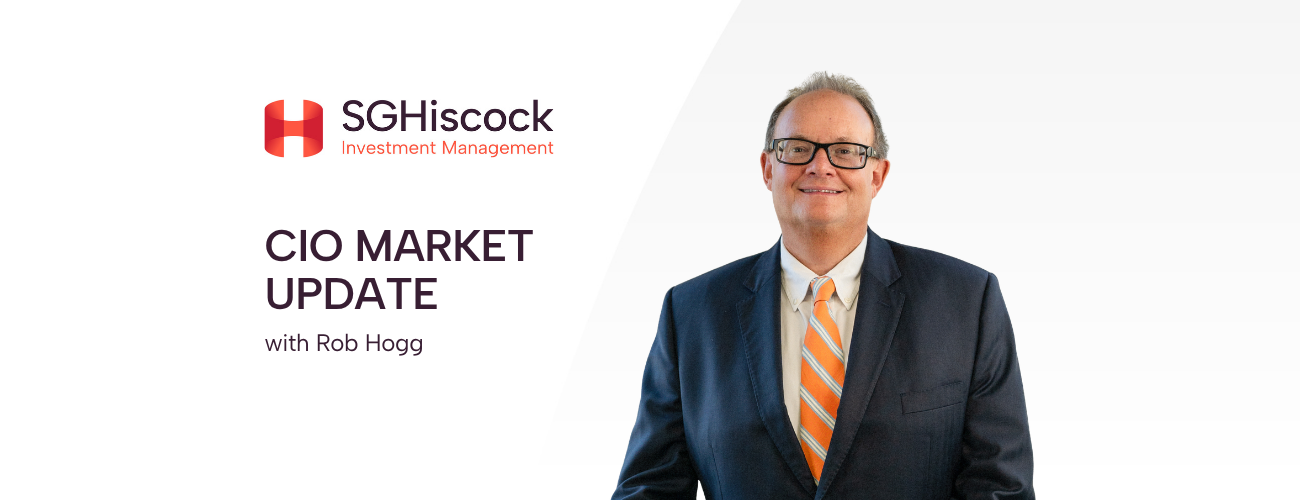
September 2025: Sticky inflation – tricky situation!
n episode #16 of The Active Investor with SGH – October 2025: Sticky inflation – tricky situation! – In this episode of The Active Investor, SG Hiscock & Company’s Executive Chair Steve Hiscock and CIO Rob Hogg unpack the theme of the past month including sticky inflation, AI, Interest Rates and interesting international and Australian market…

In episode #16 of The Active Investor with SGH – October 2025: Sticky inflation – tricky situation! – In this episode of The Active Investor, SG Hiscock & Company’s Executive Chair Steve Hiscock and CIO Rob Hogg unpack the theme of the past month including sticky inflation, AI, Interest Rates and interesting international and Australian market insights.
More places to find our podcast:
September 2025: Sticky inflation – tricky situation!
Transcript
Steve Hiscock:
Hello to everyone listening to our podcast, the Active Investor with SGH. I’m Steve Hiscock, the chair of the company, and it’s my pleasure to be your host for today’s episode. In today’s episode, we’ll be looking at what happened over September 2025 and be discussing the outlook again looking forward. This podcast is being recorded on Wednesday, the 1st of October 2025, and joining me again today is our Chief Investment Officer, Rob Hogg. Hi Rob. Welcome back again.
Rob Hogg:
Hi Steve. How are you? Good to see you.
Steve Hiscock:
Very good to see you. It’s been an interesting month. The markets have been a little bit up and down. The Australian market was a bit down, the US market was a bit up. Can you talk through what happened in the month?
Rob Hogg:
So it was a month where what happened in Australia was a little bit different to what happened elsewhere. So, look, the US S&P equity market is up about 3.5%. Most of the markets around the world were up a couple of per cent for the month. They broadly rose throughout the month, and several markets again reached record highs.
Now Australia was a bit different. The broader market, as indicated by the ASX 300 accumulation index, looks at the total return of the market, which actually slipped by a little over half a per cent for the month. In contrast to what we saw globally, small companies here performed better than that.
They were actually up around 3.5%. Another thing that really made Australia stand out was the magnitude of the move in shorter-term interest rates here. And look, I think the two are connected. The rise we saw in short-term bond yields and the weakness in the broader market, I think they are connected, and we’ll talk about that. The only other thing I think worth mentioning is just the gold price up another 10% in September. It’s getting up to close to an increase of 50% year to date. An incredible run continued.
Steve Hiscock:
And look, not wanting to be too proud or anything, but it does look a little bit like small companies have started to come back. And you mentioned that small companies in Australia have started to outperform. One of our key focuses at SGH is on small companies, and our small company trusts performed incredibly well, with returns of 13% or more, and in one case, over 20%. I really think now is the time to look at small companies. They’ve underperformed for a long time, and I’m sure we’ll have more to say about that in the coming months, Rob. Today, let’s have a bit of a chat about some of the things that happened in September. One of the topics you’ve been discussing recently is the current market consensus on earnings and rate cut expectations, among other things, and risks there.
Rob Hogg:
I guess what we really wanna emphasize is just if you think about the setup, the market setup.
As of today, we are discussing the US market initially. Market expectations are that the United States Federal Reserve, the central bank, will cut rates a couple of times this year and then a couple more times moving into 2026. That is the market expectation that is built into not only interest rate pricing, but also has an impact on equities. And further than that, and built around that is an expectation that the US economy will soft land. We’ve seen a little bit of softness, particularly in the employment market, and the expectation in forward market earnings and so on is that weakness will likely continue, but won’t be significant.
And that sort of soft landing, which is what that sort of implies together with rate cuts, that’s generally a pretty positive environment for equity markets, risk markets more broadly, but that’s exactly what’s priced in today. So, as we sit here doing the podcast today, that is what the market expects. So, there are risks around that.
One of the ones we’ve been talking about for a while is the inflation risk, ’cause inflation pressures need to ease for the Fed, the US Central Bank, to continue cutting rates. Now, the catch is that, as happened again last month, the underlying inflation momentum is continuing to edge higher. It’s not rocketing, but it’s not going down. It’s edging higher. So were that to continue, that really constrains what the Fed can do, and harking back, the market expects ’em to cut rates like another four times. If there’s anything that prevents them from doing that, like inflation, that is a potential risk to this consensus.
The other one on the other side is that, rather than a soft landing, in fact, we get a nasty downside surprise, perhaps with something like employment. So, if we were to get a monthly payroll number that was negative, that could potentially be the beginning of a trigger to make the market reassess its sense of soft landing. In other words, if the probability of recession starts to rise in the market’s mind, that is definitely not priced in. So, higher inflation constraining the Fed is not priced in, and a nasty downside surprise with growth, perhaps exhibited by weakness and employment, that is not priced in. So, walking a narrow path where, in many ways, the best-case scenario is currently priced.
Steve Hiscock:
Is the threat of a government shutdown a trigger? In the past, it’s been a short-term trigger, but it tends to bounce back quickly.
Rob Hogg:
Yeah, it does. And in fact, if we look at market performances around the time of government shutdowns, they’re as many times positive as negative.
Steve Hiscock
Yeah. Okay.
Rob Hogg:
I dunno, perhaps it’ll be different this time with the current administration, who do like to play hardball more than other administrations, and some of the pronouncements we’ve had from the president just in the last day or so about really taking advantage, not exactly the words, but really taking advantage of a government shutdown, that could have a more significant, potentially negative effect. But as we sit here today doing the podcast, we’re only in the very early hours of a potential.
Steve Hiscock:
Yeah. And time will tell. Sometimes these things are resolved pretty quickly. So you and I have seen quite a few of these shutdowns, Rob. We have seen a few of these shutdowns. So we know they always reopen, but it’s just what happens in the meantime.
Rob Hogg:
Yeah.
Steve Hiscock:
Brilliant. Thank you for that. So, just looking at the other months’ major developments. One of them was that the US Central Bank cut rates, to the extent that we haven’t talked about it, can you just quickly review that?
Rob Hogg:
Yeah. So yes, they cut rates as expected. What’s important with these actions is the surrounding statement, and I think the statement and the size of the cut at just that minimum 25 basis points, the statement as well describing it as risk management, but also talking about near-term risk to inflation tilted to the upside, that was, I guess, what you’d call a hawkish cut. Specifically, the market was somewhat disappointed, and we saw, from that day on, market interest rates rise. There wasn’t too much damage done to equities, although they were a bit weaker on the day. We saw more of the impact in interest rate markets, where, as we marched towards the end of the month following the Fed’s decision, rate cut pricing, although remaining, edged fractionally lower through the rest of the month.
Steve Hiscock:
So, the expectations of forward rate cuts being wound back are being reconsidered. As you mentioned earlier, perhaps the best-case scenario is being factored in, but there’s a hint of caution.
Rob Hogg:
Yeah, there is. And. The market performance we’ve seen for the reasons, that being the near-term risk to inflation, if that were to continue, we will see more and more of these rate cut expectations wound back. And that is a risk to this very positive macroeconomic scenario that the market has priced in.
Steve Hiscock:
Okay. So, in a nutshell, I have a slight concern about inflation; I guess I’m less bullish about the projection of interest rate cuts and US growth. Momentum is slowing, and that’s not a good thing. So the spectre of stagflation has not disappeared.
Rob Hogg:
No it hasn’t. However, we have suggested that this could be an environment into which the US moves, but so far, it has managed to avoid that. Growth momentum slowing, yes. But only ever so slowly. And the economy is still expanding. And inflation, yes, it’s moving up. However, again, ever so slowly, we are talking about the risk being an extrapolation of these trends that have been in place for some time. But I think if anything, the market continues to be surprised by just how slow these trends are occurring.
Steve Hiscock:
Okay. Let’s talk about AI. It wouldn’t be 2025 if we didn’t talk about AI again. It’s again been a key driver in September in the US. Can we talk about that?
Rob Hogg:
Yeah, so NASDAQ Index, about the best performing major index in the US and one of the best in the world for that matter, in September, up around five and a half per cent. And look, a lot of this is back to the whole AI thematics. Therefore, it’s all the capital expenditure that the market expects will be necessary to facilitate the computing power required for AI. So that’s, as we all know, the thematic. And that’s been a very important driver of equity market returns, not just this year, but it came back with a vengeance in September.
And interestingly enough, we had during the months another report or another research piece that sort of questions some of the blue sky that’s built in. So in this particular case last month, Bain Consulting released a report, in fact, their annual global technology report, and really what they were talking about was the fact that the expectations for the amount of compute power required is going to cost such an incredible amount that it’s hard to imagine industry being able to actually allocate that amount of capital to CapEx of this nature.
The other thing that’s important is just how is just how key Tech CapEx has been even this year. Over the past year, AI-related CapEx has grown by 15% in nominal terms. In the first half of this calendar year, it has contributed around half a point to the overall GDP. So, it’s already making an incredibly powerful contribution.
Now, why is all of this important? For a couple of reasons. One question is whether the industry will actually have the capacity to invest in line with expectations. But two, will the return on that CapEx meet what is required to make the CapEx investments in the first place? So, anything that should question either of those two elements of the story could lead to a revision of expectations in related to the whole AI thematic. So, this is not saying AI is going away at all. Not saying it won’t be incredibly transformative. All it’s saying is that, can the investment that’s expected actually occur in the volumes required, and is the return on investment going to be what investors today are currently expecting?
Steve Hiscock:
And not to sound like a 60-plus-year-old historian here, but if you go back to the Dot Com boom, the market got very excited about it. And it was right. The internet has transformed the way businesses operate. However, the evaluations and the CapEx involved at the time saw companies collapse because they weren’t able to deliver on the CapEx that they spent. So, the issue and concern I have is that, yes, AI is going to transform the way the world does business, but will the current crop of AI beneficiaries necessarily be the ones to invest in for the next 20 years? It may not necessarily be the case, and we may see some fallout, Rob, which is what you’re kinda saying, right?
Rob Hogg:
Yeah, it can just be a very slow burn. We’ve been having this same discussion for months and months, and back in the 1990s, as you and I both remember, these discussions went on for months and months.
Steve Hiscock:
They did.
Rob Hogg:
It was four or five years before the year 2000, I think, that Alan Greenspan, the chair of the Fed at the time, spoke of irrational exuberance. That exuberance can go on quite some time.
Steve Hiscock:
Okay. Let’s talk about Australia. Obviously, the central part of our portfolios acknowledging obviously that the US and the world has got such a big part to play in what we do. The monthly inflation figure, how does that- how has that weighed on the hopes that we have for rate cuts in 2025? There’s been a change.
Rob Hogg:
I think Australia’s a really interesting example of what we might see globally. So monthly, CPI, around the middle of the month for August, it’s fractionally more than expected, but really not a lot, but as is often the case with stats, it’s not the headline that’s always the most important thing. It’s what contributes to the outcome. And in this particular case, during the August CPI, what was really driving this very slight upside surprise was a phenomenon called inflation in Market Services.
So, what are Market Services? They’re things that are very driven by wage costs. So, they’re domestically traded, things that you can’t import. The pressures in those types of services, and the costings, are driven by wages and they tend to be very sticky. And this is really one of the themes of the month, sticky inflation. It’s the same in the US. Sticky inflation is, if anything, picking up momentum, and sticky inflation, of course, by definition, you would imagine, is the hardest type of inflation to ring out of the system.
Steve Hiscock:
Yeah. Is it a lagging thing? Are we seeing the effects of other stuff? Does that mean it’ll ring its way out of the system eventually?
Rob Hogg:
At some point in time.
Steve Hiscock:
Okay.
Rob Hogg:
Before we get there, what’s been done in the near term is it’s caused rate cut expectations here to move from a November cut all the way out to a March-April rate cut.
Steve Hiscock:
And I saw NAB is projecting May.
Rob Hogg:
I’m sure there are probably analysts out there saying that the RBA is done. So, this is a risk we’ve been talking about for a little while, that expectations for rate cuts could be stymied by inflation stickiness. And that’s what we saw during August: sticky inflation, which is something the RBA cannot ignore. It’s not gonna disappear overnight. It’s not due to oil prices and is really cyclical. It’s much more difficult to move than that. And this is the kind of thing that could prevent them from cutting rates.
So, market pricings changed. Again, it’s been moving in this direction, but that has already been reflected in the yield curve. It’s already been reflected, I think, by the performance of Aussie equities during the month, and I think it’s one of the reasons why the broader market here was slightly negative for the month.
Steve Hiscock:
Yeah.
Rob Hogg:
That’s the pricing in of a less and less supportive interest rate environment. And that is the risk in the rest of the world that, particularly in the US, four rate cuts to this year, couple of next year, the risk is sticky inflation there, which we know is also occurring, is something that causes market pricing there to move similarly which will likely have a negative impact on equity markets, should it all come about.
Steve Hiscock:
And that leads us to the next thing, which is the economy itself. So, the concern I have is that I don’t want to be overdramatic, but it feels like the economy is on the cusp. And if rate cuts aren’t forthcoming, then what we’re gonna get is a slowing economy. The economy’s doing okay at the moment, isn’t it?
Rob Hogg:
Yeah, no, it’s been picking up.
Steve Hiscock:
Yeah. But, is that gonna reverse, do you think? If we push rate cuts out to May even, what happens then?
Rob Hogg:
It’ll be interesting to see perhaps what happens with house prices. The most recent release for house prices shows another solid pickup. And we’re now seeing momentum in dwelling values rising not only in the capital cities and all the capital cities, but also across key regional centers as well. So, it’s broadening out and as well, price increases are now starting to pick up a little more in more mid-priced dwellings. Whereas up until now, it’d only really been dwellings at the cheaper end of the spectrum.
So that’s a sign. As well as the broadening in house prices is starting to gather more momentum as well. So, the risk is that all the talk and expectations of further rate cuts, which is priced into what people decide to do today, that does run the risk yes, of nipping some of this upward momentum.
However, as of today, housing prices appear to have regained momentum. It’s broadening as we said. Things like business forward orders have been picking up for a while as well, and that continues to be the case in the most recent months. So, it’s looking like the three rate cuts so far starting to affect the economy positively. Yeah, the risk is that if, because of inflation rate cuts get completely discounted out of people’s expectations. There is, yes, a potential there that some of this momentum might be nipped a tiny weenie bit.
Steve Hiscock
And employment?
Rob Hogg:
Look, employment’s been a very strange animal. It performed much more powerfully last year when the economy was much, much weaker. The reason for this was that a significant portion of the employment growth was driven by public sector employment, particularly in the health sector. So, we had stronger employment last year in a weak economy. What we’re now getting, somewhat bizarrely, but in a reflection of that, is weaker employment, even as the economy’s picking up; it seems, though, some of that is payback for the unsustainable strength in public sector employment. Now that’s softening, it’s softening at a pace that’s almost taking out the positive impetus from private sector-driven employment.
So, on the surface, it looks like employment’s weakening, but I think what’s happening is there’s a change in composition and there were changing engines, if you like, from public sector-driven employment to private sector. But at the moment the huge positive influence of public sector washing out is having a more negative impact than the private sector can really fill up, if you like.
Steve Hiscock:
And so I’m bringing you back to the share market, which is obviously important to us. So, the big end of town, the top 100, has lagged a bit. The small company side has really started to show a continued resurgence. Is that consistent with what you’re seeing? Is that reflecting a slowdown in the broader economy, but more opportunities in small companies?
Rob Hogg:
Yeah, look, I think it is, I think it’s also reflective of the fact that we’ve been talking for a while now, that really the small ordinary, the smaller part of the market has so underperformed the larger part of the market that the relative valuations were moving further and further apart. And at some point in time you’d get a catalyst to start moving the valuations a little bit closer. And that’s what happened in September, and it’s been happening now for a little while. We view this from the perspective of the relative forward PE. Small Ords are still trading at a greater discount than they typically do on average, but the size of that discount has started to close.
So that’s in large part a lot of what we’ve seen in the last couple of months. It’s a change in really the market’s comfort and interest in smalls, and that’s been reflected partly in a slight closing in this valuation gap that could still have quite a bit of room to go.
Steve Hiscock:
And it has been led, although most sectors has done pretty well in small companies, but it’s certainly been led by materials, hasn’t it? Gold and silver have been on an absolute run.
Rob Hogg:
They have been on an absolute tear, and we mentioned earlier that the gold price is up another 10% in September. So that has only added further momentum to what had already been a trend well in place.
Steve Hiscock:
Okay. Thank you, Rob. Let’s discuss the outlook.
Rob Hogg:
Look, we’ve said it for a little while, we’re cautious. The reason we’re cautious is the arguments we were talking about earlier, and that is, just how much of the rate cut scenario will actually be forthcoming. It’s all about the inflation constraints. We also overlay that and the potential downside risk there if the policy environment, the rate cut environment is not as positive as expected, and/or the growth environment is not as soft a landing as expected. But we overlay that with valuation. Simple valuations. We know valuations are toward the top end of their sort of historic range, and that’s when there’s potential for some of these negative risks to have a more significant impact when you’ve already got pretty high valuations and pretty high expectations for the forward earnings cycle.
Again, in Australia, yes, valuations here are toward the top of their range, but it just seems that the underlying macro is moving in a better direction. The economy does seem to be picking up. We know inflation was a little bit stickier than the RBA and investors had hoped for. But the RBA has room to cut rates should there be any hiccups on the growth side. Because they were likely, as you were pointing out earlier, with inflation, if we do get a hiccup in growth, you’re likely to get inflation pressures easing.
And the RBA then has the room to move a little more so to accommodate and try and cushion any potential downside. So broadly speaking, we’re cautious. A lot of good stuff’s being priced in here in Aus. There’s room on the policy side to accommodate that either fiscally or from a monetary point of view, should things start to soften.
Steve Hiscock:
And that’s where Australia is in a good position. It’s got firepower, should we need it. So there is some cause for optimism, and as you say, we’re cautious. But there are levers they can pull to protect us, and I think that probably gives us comfort as investors. There’s no doubt the market’s expensive still. However, we’re certainly not calling for an immediate downdraft or anything.
Rob Hogg:
Yes, Steve. I think that’s absolutely right.
Steve Hiscock:
Great. Rob, thanks so much for your time. That brings us to the end of today’s podcast. We looked at what happened on September 2nd, 2025. We’ve had a bit of a chat about inflation and growth and the difference in markets. There are mixed views, but in Australia’s case, we obviously have the ability to protect the market and the economy through interest rate cuts if needed.
We hope you enjoyed today’s podcast. Please subscribe so you don’t miss out on future podcasts. Follow us on LinkedIn, YouTube, Spotify, Apple, or wherever you get your podcasts from. Please do let us know if you have any questions or comments. And until next time, stay informed and stay active.
This podcast is produced by SG Hiscock and Company. It does not constitute financial advice and assumes a certain level of knowledge. It is general information only and does not take into account the investment objectives, financial situation, or needs of any person, and should not be considered a recommendation.
Follow us on LinkedIn, YouTube, Spotify, Apple, or wherever you get your podcasts from.
Please let us know if you have any questions or comments. Until next time, stay informed and stay active.
___
Disclaimer:
This podcast is produced by SG Hiscock and Company. It does not constitute financial advice and assumes a certain level of knowledge. It’s general information only and does not take into account the investment objectives, financial situation, or needs of any person and should not be considered a recommendation. For more information, visit: https://sghiscock.com.au/podcast-disclosures-and-disclaimers/.

SG Hiscock & Company, trading as SGHiscock Investment Management (SGHiscock) has prepared this article for general information purposes only. It does not contain investment recommendations nor provide investment advice. Neither SGHiscock nor its related entities, directors or officers guarantee the performance of the Funds. SGHiscock also doesn’t guarantee the repayment of capital or income invested in the Funds. Past performance is not necessarily indicative of future performance. Professional investment advice can help you determine your risk tolerance as well as your need to attain a particular return on your investment. We strongly encourage you to obtain detailed professional advice. We recommend that you read the relevant Product Disclosure Statement and Target Market Determination, if appropriate, in full before making an investment decision. SGHiscock publishes information on this platform that is, to the best of its knowledge, current at the time of publication. It is not liable for any direct or indirect losses attributable to omissions, outdated, inaccurate, incomplete or deficient information. Investors and their advisers should make their own enquiries before making investment decisions.
Stay in the loop
Get the latest insights and company news direct to your inbox.