
SGH Enhanced Income Trust update – Q1 2025
In this SGH Enhanced Income Trust update, Stratton Bell outlines how the fund delivered strong returns amid volatility and why it remains focused on capital protection and income.
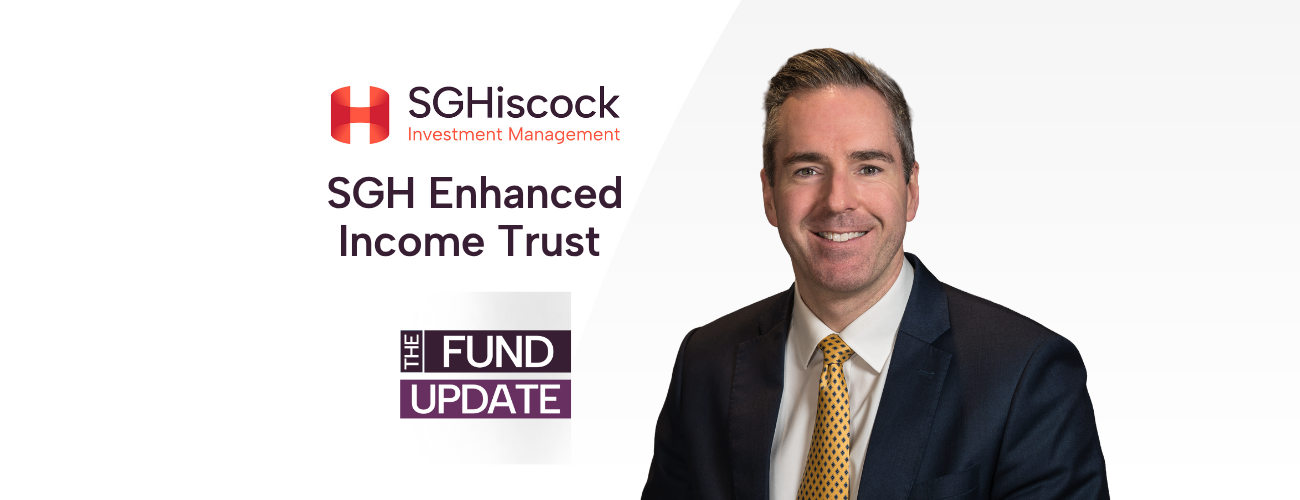
In this SGH Enhanced Income Trust update, Stratton Bell, Portfolio Manager of the SGH Enhanced Income Trust, discusses the trust’s Q1 2025 performance, market conditions driving volatility, and why the strategy remains focused on capital protection and consistent yield. He also outlines the diversification benefits fixed-income investments can offer amid equity market declines.
Transcript:
Enhanced Income Trust update: Delivering strong returns in a volatile quarter
The SGH Enhanced Income Trust returned 1.3% for the quarter, after all fees and before any benefit of franking credits. It slightly underperformed the benchmark by one basis point. So, from an absolute perspective, that was a very good return for the quarter, and there were several drivers towards that.
The first one was underperformance in the hybrid market. The listed hybrid market slightly underperformed what we saw on the unlisted side, and that was due to volatility, mainly in January. The reason for that was the markets trying to price in the effect of the Trump tariffs across many nations.
We saw that both on the credit side and also on the interest rate side. Another factor driving the market was the RBA’s announcement of a 25 basis point decrease in interest rates. Given that the majority of the Enhanced Income Trust is invested in floating rate instruments, this will cause the returns for the next six to 12 months and going forward to be slightly lower by about 25 basis points than what they’ve historically been.
Resilience in volatile markets and a falling rate environment
Given the market’s weakness, it is expecting further interest rates and cuts. Despite this, we expect the trust to continue to be solid and provide a good level of capital conservatism going forward. The SGH Enhanced Income Trust is positioned to provide capital protection and yield for investors.
This is across all markets. What we’re seeing now is exactly what we had thought would happen – volatility. The return of 1.3% has been quite strong for the quarter in this high-stress environment. Especially when we look at the returns of the Enhanced Income Trust versus the ASX 300 for the quarter. ASX 300 is down almost 3% versus the trust, which is up. And this lower or sometimes negative correlation can actually be very positive. So, we see the portfolio going forward as continuing to churn out this yield, given the volatility we’re seeing at the moment.
Portfolio positioning: Remaining steady and selective
We haven’t made any significant changes during the last quarter.
We still are looking for fixed-rate investments at attractive prices that can provide good capital protection. We’re cognisant of interest rates declining, and these fixed-rate investments should pose or provide an underlying flaw of interest rates as we expect interest rates to decline over the next 12 months.
Why consider the Enhanced Income Trust?
There are three reasons why investors should consider the SGH Enhanced Income Trust as part of their investment strategy. The first one is the great diversification benefit that comes from fixed-income products. As we saw in the past quarter, many equity markets have posted negative returns, while the Enhanced Income Trust has posted a positive return.
The second one is that we expect the total return of the Enhanced Income Trust to be in excess of 5% after all fees and before any benefit of franking credits, which is quite strong given the current environment. And the final one would be if you compare this investment versus a term deposit, there is no lockup period, and investors can get their money back within seven days, unlike a term deposit where if you were going go to a bank, there is that lockup period for three, six or 12 months with the money sitting there, that provides it very difficult for managers to be very dynamic with their asset allocation decisions, and especially important when you want to switch out if there is if we go into a very bear market.
For more information about the Enhanced Income Trust, click HERE.
*The text has been edited for clarity.
Disclaimer:
The document contains general information only. Reference to either individual securities or other investments should not be considered as investment advice. We strongly encourage you to obtain professional advice before making an investment in securities that have been mentioned. Documents you should consider prior to making an investment could include the relevant Product Disclosure Statement and the accompanying Target Market Determination. If you would like further information on financial products that SG Hiscock & Company Ltd (AFSL 240679) is the investment manager for, contact the Client Services team on 1300 133 451, visit the website sghiscock.com.au or contact your financial adviser. Any investment is subject to risk, including possible loss of income or capital invested.

SG Hiscock & Company, trading as SGHiscock Investment Management (SGHiscock) has prepared this article for general information purposes only. It does not contain investment recommendations nor provide investment advice. Neither SGHiscock nor its related entities, directors or officers guarantee the performance of the Funds. SGHiscock also doesn’t guarantee the repayment of capital or income invested in the Funds. Past performance is not necessarily indicative of future performance. Professional investment advice can help you determine your risk tolerance as well as your need to attain a particular return on your investment. We strongly encourage you to obtain detailed professional advice. We recommend that you read the relevant Product Disclosure Statement and Target Market Determination, if appropriate, in full before making an investment decision. SGHiscock publishes information on this platform that is, to the best of its knowledge, current at the time of publication. It is not liable for any direct or indirect losses attributable to omissions, outdated, inaccurate, incomplete or deficient information. Investors and their advisers should make their own enquiries before making investment decisions.
Stay in the loop
Get the latest insights and company news direct to your inbox.