
SGH Opportunities Fund update – March Quarter 2026
SGH Opportunities Fund update: March Quarter 2026
SGH Opportunities Fund update: March Quarter 2026
Watch/Listen to the March Quarter 2026 SGH Opportunities Fund update ⏬:
Transcript:
SGH Opportunities Fund performance for the quarter
Rory Hunter
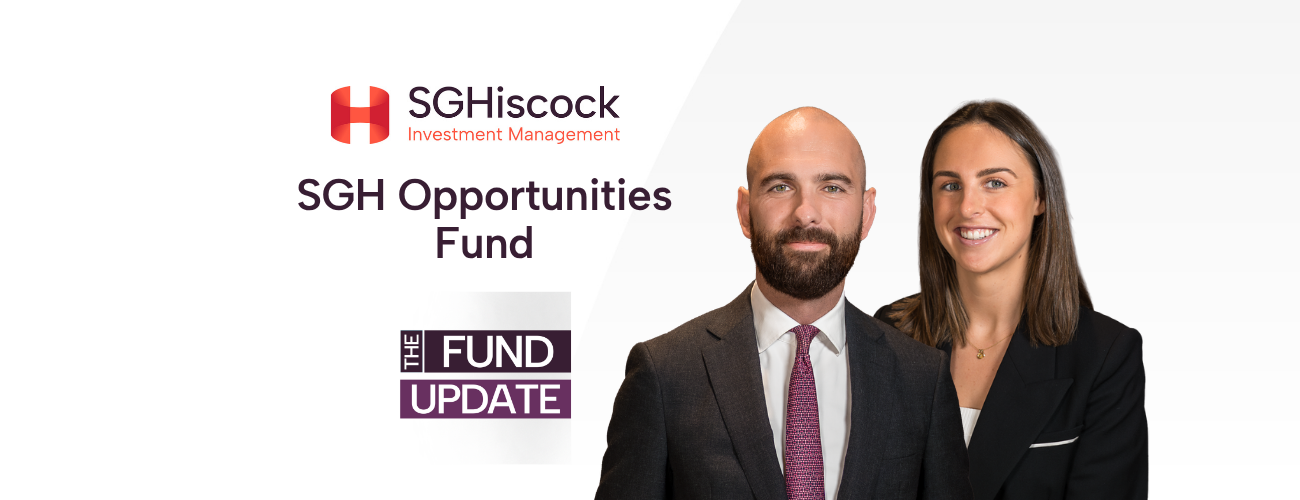
Welcome back to the SGH Opportunities Fund quarterly updates. I’m Rory, and with me is Sophie. Soph, great to have you.
Sophie Smith
Thanks, Rory. Good to be back. Definitely a more complex quarter this time round, it feels like we’ve moved into a much more macro driven environment. So, how are you framing this quarter overall?
Key drivers of performance
Rory Hunter
Yeah, it’s been a clear shift. So, the March quarter really marked a transition from a market driven by sector tailwinds, particularly in resources to one that’s much more macro driven and volatile. We’ve seen a rotation in leadership increased dispersion across sectors, and a lot more sensitivity to global macro, particularly inflation interest rates and geopolitics. That’s meant performance has been less about riding thematic momentum and more about positioning and capital allocation through the cycle.
Sophie Smith
And I think the dispersion point is key. We’ve seen much bigger differences in outcomes across sectors and stocks than we have a few months ago. So that shift really showed up in March specifically, I think as well.
Rory Hunter
Yeah, it did. So, March was weak month overall, but what stood out was really the reversal in commodities. So small ordinaries fell over 8% and underperformed large caps. While gold equities actually saw a particularly sharp correction the all ordinaries gold index was down nearly 24% for the month, effectively unwinding the prior three months of gains.
The drivers were largely technical profit taking after a strong run, ETF outflows and some shifts in central bank behaviour around gold reserves. In particular the Central Bank of Turkey selling significant levels of their reserves. Importantly we didn’t view this as a structural break in the gold story. The underlying fundamentals haven’t actually materially changed. It’s more about a positioning unwind than a reset in the thesis.
Sophie Smith
Which is quite consistent with how these trades behave. When positioning gets crowded, the corrections tend to be sharp and fast. So outside of commodities, the macro backdrop has become more challenging too, I think.
Rory Hunter
Yeah, that’s right. Significantly more complex. The escalation in the Middle East conflict is pushed energy prices higher, which is now feeding into inflation expectations and global rate settings. At the same time, we’re seeing a deterioration in domestic demand, and that’s particularly telling consumer discretionary has weakened services activity has rolled over and confidence remains subdued. So, markets in our really grappling with a two-sided risk if central banks prioritize inflation that pressures growth, but if they pivot towards growth, you risk currency weakness and imported inflation. So that uncertainty is what’s driving the volatility and the dispersion that we’re seeing.
Sophie Smith
And it’s quite a difficult environment for markets to price.
You don’t have a clear dominant narrative at the moment. So, we’ve also seen that uncertainty flow through into tech, particularly software.
Current fund positioning
Rory Hunter
Yeah, and that’s been a major theme this quarter and to an extent last quarter as well. So, we’ve seen broad repricing of software in capital light business models globally driven by two key factors.
So, the first one being artificial intelligence and the fact that artificial intelligence is lowering barriers to entry and compressing differentiation across many software businesses particularly those without strong workflow integration or proprietary data advantages. Second, the scale of capital actually required to support AI, particularly compute infrastructure, is much larger than the market had previously anticipated.
So, it’s not just about disruption, it’s also about the economics of sustaining that disruption. And now that’s really led to a reset in expectations around margins, competitive advantage and terminal value, and really driven a rotation towards what are increasingly being described as HALO businesses. So that’s heavy assets, low obsolescence.
Sophie Smith
And that really aligns quite closely with where we’ve been focusing.
So, businesses with more tangible backing and structural durability. So now let’s unpack how we’ve been positioning for this shift.
Rory Hunter
So, I feel that we’ve been relatively well positioned and relatively well positioned for the medium and long term. We’ve had limited exposure to the more crowded, highly valued parts of the software market, and where we do have exposure, say the likes of Energy One, so that’s AOXEOL, it’s in niche mission critical systems with high switching costs and strong integration into customer workflows. Now, importantly, we’re also seeing structural tailwinds emerging in that market. So European energy markets are increasingly moving towards extended trading ads. In some cases, they’re shifting away from roughly 10 hour trading windows closer to 20 plus as a day driven by higher volatility, increased renewables penetration, and the need for continuous risk management. This this has really been exacerbated by what we’ve seen over the past six weeks with the conflict in the Middle East. Now that materially increases the complexity of trading and portfolio optimization for participants in those energy markets, and in turn raises the importance of integrating trading and risk management platforms like that of Energy One.
So, we think that sort of dynamic reinforces both the stickiness of the product and the long-term growth opportunity as market structure continues. To evolve on the resources side, we’ve been actively managing our positions, so we’ve been taking some profits into the strength in previous quarters and earlier in this quarter, and recycling capital into opportunities where we think are being mispriced, following the recent pullback.
So that capital recycling has been particularly important in this environment. It allows us to improve portfolio quality without increasing overall risk as such.
Sophie Smith
Yeah. And that discipline becomes even more important when markets moving as quickly as they are at the moment. So, from a portfolio perspective, one of the more notable stock specific developments this quarter was Lumos.
Rory Hunter
Yeah, so Lumos Diagnostics was a key highlight. They secured FDA clear waiver approval for their FebriDx product, which is a major inflection point for the business. It expands the addressable market in the US really significantly to around 80 million patients and also allows the product to be used across a much broader range of care settings.
So, this effectively transitions Lumos from a regulatory driven story to a commercial execution story. They also strengthened the balance sheet through non-diluted funding and the capital raise, which we participated in. So, we are well positioned as they move into that next phase, that commercialization phase.
Sophie Smith
And it’s a good example of where even in a macro driven environment like we are in now, you can really get meaningful stock specific catalyst still. So, in March we also went to the Euros Hartley Resources and Industrials conference. What stood out there for you?
Rory Hunter
Yeah, it was a really strong conference this year.
Attendance was up very significantly and there was a noticeable increase in global investor interest in Australian resources. So really strong attendance by international funds, particularly those out of the UK and the US. What stood out was that despite the recent pullback, the medium-term outlook for commodities remains constructive. There’s still a strong focus on structural themes like electrification, copper demand, and ongoing M&A activity. So, while the near-term path is more volatile, the underlying thesis really remains intact.
Sophie Smith
It definitely did feel like the pullback was being viewed as an opportunity rather than a change in direction. So, based on that, how are you thinking about the outlook from here?
Reasons to invest in the fund
Rory Hunter
Yeah, so in the near term, we expect volatility to remain elevated. There’s still a lot of uncertainty around what’s going on in the Middle East and the impact on inflation growth and those geopolitical developments.
But stepping back, we really do may remain constructive. The recent pullback, particularly around resources and across the resources space is starting to create. Selective opportunities and increased dispersion across the market is typically a good environment for active stock pickers. Our focus remains on a few things, businesses with strong asset backing, exposure to structural themes like energy, electrification and supply chains, and companies with clear pathways to earnings growth.
Sophie Smith
So, it sounds like the summary is a more challenging environment, but also one where being selective and disciplined should continue to drive some outcomes.
Rory Hunter
Yeah, exactly that, Soph. We’re seeing a lot of discounted share prices and that’s creating a lot of opportunity.
Sophie Smith
Thanks for tuning into the SGH Opportunities Fund quarterly update.
We’ll be back next quarter with more.
Rory Hunter
Thanks everyone.
*The text has been edited for clarity.
For more information about the SGH Opportunities Fund, click HERE. Follow us on LinkedIn.
Disclaimer
This fund update has been prepared by SG Hiscock & Company (SGH) to provide general information only and is not intended to take the place of professional advice. It does not take into account the investment objectives, financial situation or particular needs of any particular person.
Equity Trustees is the responsible entity for the SGH Opportunities Fund. Neither SGH, Equity Trustees nor any of its related parties provide any warranty of accuracy. Past performance should not be taken as an indicator of future performance. You should obtain a copy of the Product Disclosure Statement before making a decision about whether to invest in this product. Follow the link for the full disclaimer: https://sghiscock.com.au/podcast-disclosures-and-disclaimers/.

SG Hiscock & Company, trading as SGHiscock Investment Management (SGHiscock) has prepared this article for general information purposes only. It does not contain investment recommendations nor provide investment advice. Neither SGHiscock nor its related entities, directors or officers guarantee the performance of the Funds. SGHiscock also doesn’t guarantee the repayment of capital or income invested in the Funds. Past performance is not necessarily indicative of future performance. Professional investment advice can help you determine your risk tolerance as well as your need to attain a particular return on your investment. We strongly encourage you to obtain detailed professional advice. We recommend that you read the relevant Product Disclosure Statement and Target Market Determination, if appropriate, in full before making an investment decision. SGHiscock publishes information on this platform that is, to the best of its knowledge, current at the time of publication. It is not liable for any direct or indirect losses attributable to omissions, outdated, inaccurate, incomplete or deficient information. Investors and their advisers should make their own enquiries before making investment decisions.
Stay in the loop
Get the latest insights and company news direct to your inbox.