

CIO market update for August 2026
In this CIO market update, Rob Hogg reviews August’s key market drivers. For domestic investors, the most significant market moves in August occurred in the Australian bond market where news of stronger than expected “underlying” inflation and retail sales reported late in the month pushed market yields and rate hike expectations higher. Although there was…

For domestic investors, the most significant market moves in August occurred in the Australian bond market where news of stronger than expected “underlying” inflation and retail sales reported late in the month pushed market yields and rate hike expectations higher. Although there was significant volatility under the surface with individual company share prices, the Australian August company reporting season didn’t move the overall share market by much over the month in aggregate with the broader equity market advancing 1.6%.
Global equity markets recorded mixed performances. US markets generally performed best as the Dow Jones rose 1.3%, the S&P 500 2.6% and the Nasdaq around 4%. European and Asian markets were mixed – some up, some down – although Japan performed solidly (up around 3%)
The US bond market was more settled than had been the case in July although Fed Chair Warsh’s late-month comments at the Jackson Hole conference of central bankers caused an upward reassessment of the extent of likely Fed policy tightening later this year. This reassessment caused shorter term US yields (which are more sensitive to rate hike expectations) to rise over the month, but long term yields drifted slightly lower. Most other global markets saw a generally modest drift higher in market yields of around 0.10% to 0.20% with Japan one of the worst performing markets as yields there rose around 0.15%-0.25% (bond prices fall as market yields rise)..
In currency markets, the US dollar weakened against most currencies with the notable exception of the Yen where the sharp appreciation of the Yen at end July (following joint US/Japanese intervention) lost some of its pungency by end August. Coinciding with an upward re-evaluation of the domestic monetary policy outlook, the Australian dollar (AUD) appreciated by around 2% against the weaker USD over the month.
The renewed deterioration of the situation in the Middle East war later in the month boosted the oil price with crude oil ending August around 5% higher. Gold prices had a very strong month, rallying almost 10%. Copper was also higher, but only by a comparatively modest 2%.
Macroeconomic data released during the month was generally consistent with ongoing strength in the US, particularly among forward-looking surveys, although labour market indicators softened. US inflation remains somewhat “sticky”. European data also generally continued to improve, albeit driven mainly by the uptrend in the German economy. Domestic economic news was dominated by the continued robust trend for inflation and household spending even as the housing market continued to soften. Domestic rate hike expectations moved higher over the month.
Key market movements over August were as follows:
- S&P/ASX300 Accumulation Index (i.e., including dividends) rose by 1.6%.
- S&P/ASX Small Ordinaries (Australian Small Companies) Accumulation Index returned 5.2%.
- US equity market (S&P 500) rose 2.61%.
- Measures of market volatility generally continued to ease with both bond market volatility (the MOVE index) and equity market volatility (the VIX index) retreating further
- The US bond market ended the month with the yield curve having flattened as yields on longer-dated securities (30-year bonds) fell around 0.03% while shorter-dated yields (2-year notes) ended 0.05% higher.
- The Australian bond market behaved very differently to the US, dominated by the upside surprise to inflation and household spending news, which caused the curve to move upward by around 0.15% across the yield curve, albeit fractionally more at the short end (2- and 3-year bonds)
- Apart from the Yen, the USD gave up ground against most currencies over the month – depreciating around 2% compared with the AUD.
As we have been noting in recent months, the global economy seems to have weathered the impact of the Middle East war far better than most investors had feared. Initial sharp falls in household and corporate sentiment/confidence surveys have not been followed by similarly weak economic data. And, as economies have proved generally resilient, these sentiment surveys have now begun to recover from their lows. In fact, most surveys of corporate sentiment (ISM and S&P Global) are now displaying rising positive momentum.
But risks emanating from the war are not over – key remains the risk of a renewed and persistent rise in the oil price which could negatively impact consumer and corporate sentiment, corrode (still) generally well-behaved inflation expectations, and force central banks into rate hikes.
Other risks to the market outlook include the potential for a re-evaluation of the returns likely to follow from the current substantial investment being made into artificial intelligence (AI), and the continued increase in bond yields.
On the risk of investors downgrading their return expectations form AI-related investment, the recent earnings update from US firm Nvidia was instructive, and helped maintain a positive tone for the month. Nvidia’s outlook for approximately 70% revenue growth over the next year exceeded prior market expectations although gross-margin guidance was a little lower (because of elevated memory costs).
However, as well as declining margins, a key risk for the stock is Nvidia’s rising customer financing support through leases and cloud agreements which could further increase investor concerns about the changing nature of the firm’s balance sheet and the increase of “circular funding” concerns (the funding of customer demand for Nvidia’s products).
Regarding the risk from the continued increase in global bond yields, two elements are key – the rate of the increase in yields, and the cause of the increase in yields.
The rate of increase in yields has been generally measured. During periods when the pace of yield increases has accelerated we have sometimes witnessed a response from the US administration, as occurred in August. (US bonds seem to be about the only guard rail for the Trump Administration).
These periods of yield acceleration (which are usually accompanied by rising yield volatility) are the key periods of risk, but have so far been contained
Regarding the cause of higher yields, we have noted in previous monthlies that global yields are rising because “real” yields are rising, not because inflation risk is rising.
Rising real yields can indicate an increased indigestion due to rising supply of bonds (due to rising government and corporate bond issuance) but could also indicate an upgrade in investor’s growth expectations, there being a correlation between the pace of real (GDP) growth, earnings growth and real yields. So rising real yields need not be a negative factor for financial markets.
Regarding the outlook for domestic financial markets, unfortunately the Australian economy seems to be following a slightly different trajectory to most countries, driven by the pre-existence on an upward inflationary impulse which pre-dates the Middle East war and led the RBA to tighten policy on February 3 (before the war began).
We remain of the view that it has been the change in expectations about the policy outlook (from rate cute expectations in September last year to expectations of rate hikes a few months later, and then actual hikes in early 2026) that has retarded the performance of the Australian share market (particularly for domestically focussed companies) and caused local bond yields to rise.
As we’ve been noting for several months now, it will likely only be at the point in the future when the local bond market begins to “look-through” any further potential rate hikes and instead begins to focus on potential medium-term rate cuts that this current negative sentiment could lift.
However, until we reach that point – and we seem further from that point following August data – the environment is likely to remain challenging for the Australian economy, domestically sourced equity earnings and bond markets.
Another element in the domestic outlook is the impact of the now clear weakening in the Australian housing market, but any accelerated weakening could of course bring forward the potential for an RBA rate cut.
In this monthly update we look at:
- Fed Chair Warsh causes rate hike expectations to increase following his late August speech
- As US bond yields again marched higher in early August, the Administration again reacted
- Forward-looking measures suggest that US activity is continuing to improve
- Outlook for the European economy continues to brighten
- RBA policy flexibility still constrained by “sticky” inflation – RBA now running out of time to NOT raise rates again
- Making the RBA’s job even more difficult – household spending is continuing to defy expectations of a slowdown
- When might the RBA next raise rates?
- August reporting season
- The outlook
Fed Chair Warsh causes rate hike expectations to increase following his late August speech
US Federal Reserve Board Chair Kevin Warsh gave the opening speech on August 28 at the annual Economic Policy Symposium held at Jackson Hole in the US. In a widely anticipated speech, his remarks were more “hawkish” than investors had expected, especially as he emphasised that “it’s the Fed’s job to make sure that inflation expectations do not get unanchored”.
Beginning his speech optimistically, he spoke about the potential impact of AI, noting that “We’ve come to a hinge point in history… [and] …the potential for substantially higher growth is on the rise”.
He again made the case for ending the Fed’s practice of providing the market with forward guidance about potential future monetary policy moves saying “in normal times, the role of forward guidance should be limited and circumscribed”.
But his market-moving comments concerned inflation and the potential Fed policy response if current inflation pressures do not subside:
- First Warsh noted that, at the time of the July monetary policy meeting (FOMC), the committee members felt that “inflation remained too high”. Warsh added that “while this summer’s [Personal Consumption Expenditure] PCE and CPI readings were better than expected, they do not tell me that underlying trends have meaningfully improved”.
- And in regard to the continued inflation pressure he’d identified, and the potential policy response, Warsh then noted that “We must be confident that underlying inflation is moving to our objective, clearly and at sufficient speed. Otherwise, we have work to do. That’s our job . . . our mandate . . .”
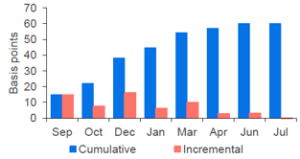
Following his speech, markets reacted by pushing shorter-term interest rates higher (2-year yields up 0.111%) as investors increased their expectations for policy rate hikes this year. By month’s end, markets were implying around 1 ½ rate hikes (+0.38%) by the time of the December 9 FOMC meeting. But it’s possible the Fed could move rates higher before December.
Expected change in the US policy rate (compared with the current 3.63% Fed Funds Rate)
Source: ANZ, Bloomberg
As US bond yields again marched higher in early August, the Administration again reacted – the US bond market is the only “guard-rail” for the Trump Administration
As US long bond yields (30-year) continued their march higher in the first half of August, the US Administration reacted with the US Treasury on August 19 announcing an increase in the size of its regular bond buy-back program (to begin on September 9).
Specifically, the U.S. Department of the Treasury will from September 9:
- increase, by at least double, the size of liquidity support buyback operations for longer-dated nominal coupon securities (the 10-year to 20-year sector and the 20-year to 30-year sector).
- Double the current maximum size of USD 2 bill per operation to at least USD 4 bill per operation.
As hoped, this announcement stopped the march higher in yields for a week or so, before 30-year yields began rising again in the last week of August.
As we have been noting, bond yields are rising because real yields are rising. Real yields are likely rising because of the increased supply of bonds (world-wide) but may also reflect upward revisions in prospective global GDP (possibly an AI-driven productivity boost).
Forward-looking measures suggest that US activity is continuing to improve
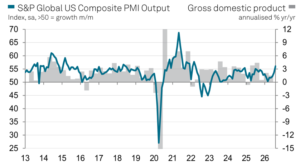
According to the S&P Global US Flash PMI for August, US business activity growth accelerated sharply for a second successive month in August to reach the fastest since April 2022. A surge in service sector business activity helped offset a marked slowing of growth in the manufacturing sector, the latter blamed in part on reduced inventory building and supply delays. Supply times lengthened sharply again, and to one of the greatest extents seen over the past four years, contributing to a further build-up of uncompleted orders across both manufacturing and services.
- “US business is booming, with firms reporting the fastest output growth for over four years so far in the third quarter as the expansion picked up further momentum in August. The survey data for the third quarter are currently pointing to annualized growth approaching 3.0%, up solidly from the 1.5% pace seen in the second quarter”.
Continued upturn in US Corporate Sentiment
Source: S&P Global
Outlook for the European economy continues to brighten
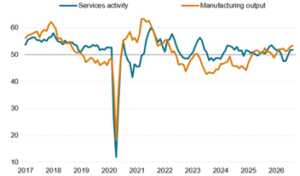
A key barometer for European corporate sentiment – the S&P Global Flash Eurozone Composite PMI Output Index – edged up to 52.1 in August from 52.0 in July, its highest since last November.
According to the authors of the survey – S&P Global – “the sustained solid rise in business activity in August sets the eurozone up for a robust increase in third-quarter GDP of around 0.3%”.
Bounce-back in European Corporate Sentiment
Source: S&P Global
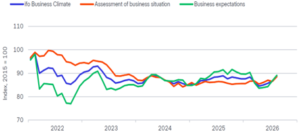
The improving European situation can probably be most clearly seen in key German sentiment surveys – in particular the ifo survey on German industries.
Ifo survey of German business sentiment
Source: Ifo Business Survey, August 2026
RBA policy flexibility still constrained by “sticky” inflation – RBA now running out of time to NOT raise rates again
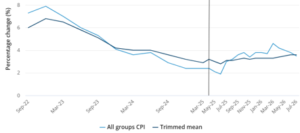
The late August release of the July CPI continued the pattern of “sticky” underlying inflation pressure – the Trimmed Mean measure was unchanged at 3.6% y/y (but accelerated to 3.9% on a six-month annualised basis).
The stickiness of inflation was further reinforced as having a homegrown tendency as evidenced by the resiliency of inflation in the services and non-tradables sectors (both running at around 4%).
All groups CPI and trimmed mean, Australia, annual movement (%)
Source: ABS
The implied probability of a rate hike by end year rose following the data:
- market pricing moved to price a near full rate cut by end year (0.22%), up from just 0.15% being priced ahead of the data
Acceleration in “Market Services” (excluding housing and volatile items) is the key area of upside pressure, and here wage growth is the key driver. See examples below:
- Restaurant meals prices rose 1.2% in July to be up 4.7% over the year (YoY),
- Cleaning and repair of clothing rose 1.0%, to be 3.8% YoY,
- Maintenance and repair of dwellings rose 0.4% to be 3.5% YoY,
- Hairdressers rose 0.6% to be 4.4% YoY,
- Other household services rose 0.6% to be 2.9% YoY,
- Maintenance and repair of vehicles rose 0.3% to be 5.9% YoY,
- Veterinary services rose 0.8% to be 3.3% YoY; and
- Sports participation rose 1.6% to be 5.0% YoY.
Making the RBA’s job even more difficult – household spending is continuing to defy expectations of a slowdown
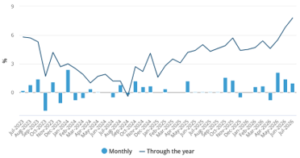
Despite three rate hikes and developing weakness in the housing market, the stronger-than-expected ABS Household Spending Indicator for July (+1.1% for the month, and 7.0% annually) drove RBA rate hike expectations higher again during the month (with the two strong data release occurring on consecutive days).
At 7%, this indicator is now exhibiting its fastest annual growth since 2023 as the economy exited COVID. The trend in annual growth in recent months is well above its average (4.7%) since the data started in 2013, and three-month momentum is accelerating also.
As well as the accelerating pace of sales, the RBA would also be troubled but the fact that its discretionary spending that is driving the strength in overall sales:
- “Spending on gambling activities, major sporting events and cinema attendance all contributed to the rise this month,” said the ABS.
Discretionary household spending
Source: ABS
The ABS data suggests a way more positive picture of the consumer than generally implied by company pronouncements during the just-completed August reporting season.
When might the RBA next raise rates?
Unless the weakening housing sector begins to more clearly negatively impact the broader economy (or some other negative factor arises), the RBA will likely have no choice but to raise rates again this year.
Timing of a further potential rate hike is most likely following the release of the quarterly trimmed mean CPI for the September quarter which will be released on September 30 – i.e.: the November 3 RBA meeting.
Ahead of the November 3 meeting, the RBA will also meet on September 28/29 (the two days before the release of the September quarter CPI). The RBA could raise rates at this pre-CPI meeting should other data suggest they can wait no longer.
The local equity market is unlikely to do well until market expectations move to rate cut expectations, but we moved further from that scenario following the release of the CPI and household spending in August.
August reporting season
As we noted in the introduction, the Australian share market returned 1.6% in August. But this modest return masked significant variation in underlying individual sector and stock performance.
Better performing sectors in August included HealthCare (+18%), Materials (+12.3%) and Utilities (+7.4%). Poorest performing sectors included Consumer Discretionary (-7.3%), AREITS (-6.7%), and Financials (-5.3%).
Macquarie analysts report that companies in aggregate beat earnings expectations and that generally forward earnings guidance was less negative than in a typical August reporting season. Resilient dividends were another theme. The Macquarie analysts note that most of the upside in earnings came from margins, cost control and mix rather than broad revenue growth – perhaps some forecasts were cut too far immediately after the Iran conflict began.
In general, results were better than feared, but not necessarily evidence of demand acceleration. For domestically orientated companies, the uncertainty arising from the policy-induced slowdown in the consumer and housing sectors was a clear theme.
Other key themes of reporting season included:
- Significant weakness in Discretionary Retail stocks as investors reassessed the prospects for discretionary retail spending in the shadow of another potential RBA rate hike – JB HiFi (-16.8%), Temple and Webster (-13.3%), and Harvey Norman (-13%),
- Weakness in the major banks for similar reasons to the weakness in discretionary retail as investors priced in the potential impact on bank earnings of slowing loan growth likely to follow the rate hikes and the deteriorating housing sector, rising competition and weaker credit quality – ANZ (-0.3%), NAB (-6.5%), CBA (-5.4%) and Westpac (-8.8%).
- In HealthCare, a sense that the worst of the earnings downgrade cycle may be over.
- Rising inflation pressures were apparent in a range of areas including higher costs for energy, transport, labour, insurance, commodities and chemicals, and construction.
- The bifurcated nature of the economy with housing/retails sectors under pressure while the side of the economy driven by investment was considerably stronger, with business lending, infrastructure, defence, mining services and data-centre spending supporting activity.
In the context of the deepening housing-related downturn, the October/November trading update period will be the next insight into how these factors are impacting domestically orientated companies.
Outlook
The global economy seems to have been less negatively impacted by the Middle East war than had been initially feared. But the renewed rise in the oil price as the Middle East peace has evaporated is cause for continued caution
The market outlook in Australia still seems more problematic than many other countries given the RBA’s current policy tightening cycle. It’s difficult to see sentiment about Australian-sourced company earnings and the Australian economy improving until expectations about the RBA’s next policy move switch to expected rate cuts.
However, it might be a mistake to regard the outlook for the local market as being negative over the medium/longer term – the local market’s recent underperformance relative to global markets (in local currency terms) owes much to local monetary policy changes in our view.
We remain slightly underweight Australian Equities, but we are closely monitoring the market for a change in these interest rate policy expectations, but this now seems further away with only a sharp continued downturn in the housing market likely to bring it forward.
A change in rate expectations could swing sentiment significantly.
Given the magnitude of underperformance of Australian Equities vs Global in local currency terms (especially US) equities, the likelihood of mean reversion is increasing, but we are also cognisant that part of the US outperformance has been driven by superior earnings and not valuation expansion, and that aspect of the US outperformance is therefore justified.

SG Hiscock & Company, trading as SGHiscock Investment Management (SGHiscock) has prepared this article for general information purposes only. It does not contain investment recommendations nor provide investment advice. Neither SGHiscock nor its related entities, directors or officers guarantee the performance of the Funds. SGHiscock also doesn’t guarantee the repayment of capital or income invested in the Funds. Past performance is not necessarily indicative of future performance. Professional investment advice can help you determine your risk tolerance as well as your need to attain a particular return on your investment. We strongly encourage you to obtain detailed professional advice. We recommend that you read the relevant Product Disclosure Statement and Target Market Determination, if appropriate, in full before making an investment decision. SGHiscock publishes information on this platform that is, to the best of its knowledge, current at the time of publication. It is not liable for any direct or indirect losses attributable to omissions, outdated, inaccurate, incomplete or deficient information. Investors and their advisers should make their own enquiries before making investment decisions.
Stay in the loop
Get the latest insights and company news direct to your inbox.