
September 2026: Better than Feared
In episode #26 of The Active Investor with SGH – September 2026: Better than Feared –In this month’s Active Investor, SGHiscock’s CIO Rob Hogg is joined by Hamish Tadgell, Head of Australian Equities, to unpack an August reporting season that proved better than feared, albeit against a backdrop of persistent inflation and continued market volatility.
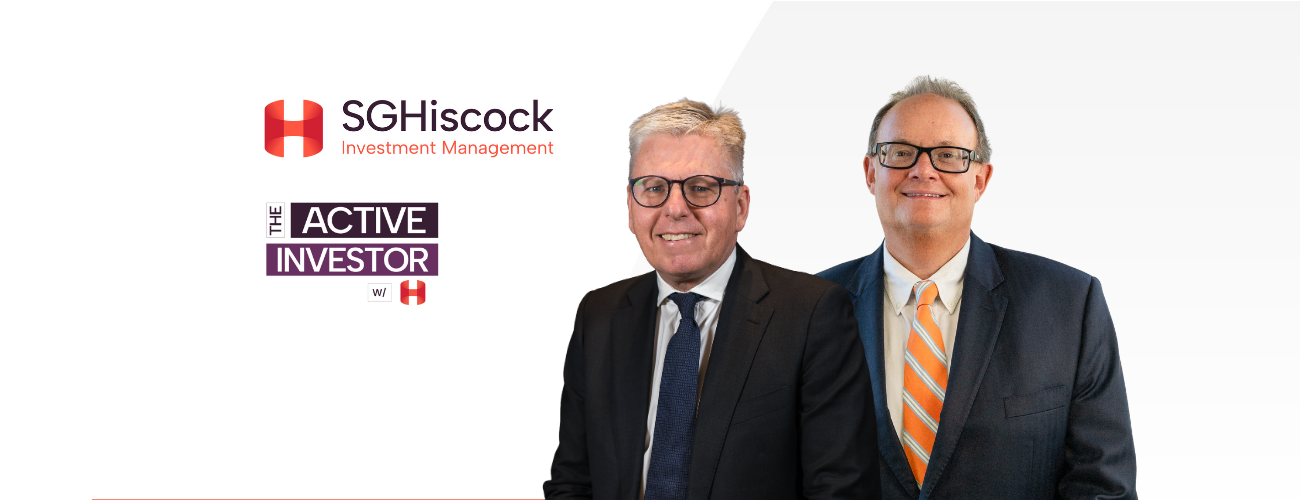
In episode #26 of The Active Investor with SGH – September 2026: Better than Feared –In this month’s Active Investor, SGHiscock’s CIO Rob Hogg is joined by Hamish Tadgell, Head of Australian Equities, to unpack an August reporting season that proved better than feared, albeit against a backdrop of persistent inflation and continued market volatility.
They explore the key sectors and themes shaping the Australian market, including the strength in resources and gold, the ongoing AI and data centre opportunity, pressures facing the consumer, and what it all means for portfolio positioning.
With valuations and earnings increasingly important, Hamish also explains why the current environment continues to favour active management and disciplined stock selection.
September 2026: Better than Feared.
Rob Hogg:
Hello, this is Rob Hogg from SGHiscock Investment Management, and welcome to the September edition of The Active Investor with SGH. Now Steve Hiscock’s away this month, but my very special guest for the month will be Hamish Tadgell, who will be taking us through some highlights of the recent August reporting season.
We’re recording this podcast on Wednesday afternoon, September 2. Today I’m joined by Hamish, Head of Australian Equities and portfolio manager for the SGH High Conviction Fund. Welcome, Hamish.
Hamish Tadgell:
Thanks, Rob. Great to be with you.
Rob Hogg:
It’s great to have you along, have a bit of a change of someone speaking on these podcasts, and particularly great to have you along given that we’ve just finished reporting season.
So, we’d be very keen to get your insights into all the ins and outs of reporting season. But if I could start with a broad question, what were your high-level takeaways of the month just gone?
Hamish Tadgell:
Look, Rob, I think I would say better than feared. I think earnings coming into– There was concerns coming into reporting season that we would see a lot of downgrades, and I think it’s fair to say that earnings did come down a bit but not as much as expected.
So if we look today, the ASX three hundred EPS growth for the next 12 months is twelve percent. If you look at that by history it’s very healthy. History’s about closer to five percent. We did, however… And I should say that is really buoyed by resources stocks. Ex resources, it’s closer to the historical average.
But and resources were strong, and I’ll come to that in a moment. But there was, I think, an air of downgrade momentum evident through this reporting season and really been evident, since March. I think the other thing I would say is that, share price volatility has remained, high. I think it’s the new normal and something that we’ve had to get used to. So there, again, a lot of, plus or minus 10% moves in, in stock prices. But a disproportionate number of the price moves, I would suggest, were more a function of less than bad or less than feared results as opposed to any genuine sort of excitement on, business improvement or necessarily strong earnings upgrades.
Small caps, I think materially did outperform large caps through reporting season. And that was evidenced by about 41% of small cap companies surprising versus about 25% of large caps. And I think that just points to perhaps where expectations were prior to reporting season, but also some improving breadth across the index so overall, as I said, I think it is a solid reporting season, probably better than feared where companies that delivered continue to get rewarded.
Rob Hogg:
Great. Thank you. That’s a great introduction. So really bottom line, better than feared. But of course, let’s start talking about the outlook a little bit.
One of the things that we grapple with, as do other investors in Australian markets, and the RBA’s are also in this boat what we’re all grappling with is the inflation story, the persistence of underlying inflation an- and cost pressures. What were some of the insights that you got during the reporting season in regard to these issues?
Hamish Tadgell:
Oh, look, Rob, I think in short, I’d say inflation is everywhere. And, it really came through in the higher costs that companies were talking about, whether it be energy costs, transport, labour costs, insurance, higher commodity price, chemical inputs into businesses, and even construction costs.
So, it’s very clear that, costs are a, a big issue. And, we also saw that very strongly, I think, in the demand comments from many companies, and there’s clear evidence that cost of living pressures are being felt. Household economy is slowing. That’s been not only just due to the interest rate increases, but clearly all through, we’re seeing it through mortgage applications, residential sales and the like.
So overall, Rob, I’d say that there was evidence that, of tightening in the financial conditions and that, inflation remains a persistent pressure.
Rob Hogg:
All right. Thank you very much. Now, one of the things, of course, that we can barely escape, we see it almost every day reported in the financial press anyway, is the whole issue of data centers and and of course, AI.
It’s a, a very hot topic increasingly, and very hot in the US obviously, but it’s getting more and more focus I think here as well. What, what sort of observations did you take away on AI and did it dominate results like we see… like we saw in Feb?
Hamish Tadgell:
There’s no doubt that it remains a hot topic.
And the conversations I think, I should say Goldman Sachs, they do a sort of a, a count, and they identify that about 60% of companies that actually reported talked about AI in their, in their results. But what I would say is that it didn’t dominate conversations quite like we saw back in February.
And I think the, the conversations were much more, I would say, mature and tended to not just focus on, shooting first and asking questions later, but rather understanding the more nuanced aspects of AI. And I think companies themselves talked to it a lot better in terms of explaining how they’re using AI and the benefits that they’re gaining from it in business. And I think particularly in some of the platform companies like SEEK, REA, Carsales I think the level of discussion and comment from companies was much more sophisticated. The other side I think is that it’s clear that AI demand is, is very strong, and many industrial companies, data center companies, those in the construction sector highlighted that real structural growth that’s occurring.
And clearly that’s feeding through to increasing, power requirements electricity availability. And I think the other thing which is clear is that- there’s large amounts of capital that need to fund this. And we are seeing companies borrowing more to fund a lot of the investment that they’re making.
Rob Hogg:
Thank you. So broadly, just reflecting on what we have, what we’ve spoken about so far, just more sort of the top-down stuff. It, basically talking about reporting season, it was better than feared. There were plenty of anecdotes and more of inflation, and AI, as you say continues to be a factor.
So that, that’s a pretty, pretty good introduction. But if we now drill down a little bit further into sector and stock themes, what sort of things came through for you during the August reporting season?
Hamish Tadgell:
Look, I think, Rob, I’d say that there’s, there’s two main things really in terms of the economy, firstly.
And we’ve really got, some, to some degree, a two-speed economy it seems at the moment. One, on the one hand, households and the consumer are weakened, have weakened. And as I said before, that’s really a result of interest rate hikes, but also, we’re seeing just the cost-of-living pressures starting to bite.
On the other side, though investment in the economy, in things, in infrastructure, in defence and mining activity, and data centres is very strong. And so we’ve also got this sort of bifurcated type economy at the moment. Against that backdrop consumer discretionary stocks really struggled.
And we saw that they tended to underperform through reporting season and the trading updates tended to disappoint versus consensus. On the other side, things like data centres were the clearest evidence of where things are strong, and any companies involved in that connectivity and hardware construction activity service, electrical services to those entities really benefited.
The other sector I would really call out was the healthcare sector. It had a record month. It was up 19% and it really, I think, high was due to the fact that we’ve actually, I think, seen a bit of a turning in a number of names in the sector, but principally CSL where we’ve gone from negative earnings momentum really for a number of years now to some signs that may be bottoming out and some really improved performance. And we saw that across CSL, Ramsey Ansell and a rally back in Pro Medicus, which has been hit quite hard more recently. And I just caveat though that a lot of that rally was really due to PE or valuation re-ratings rather than a fundamental improvement in the earnings businesses. As I said before, better than feared and market responded to that.
Rob Hogg:
Great. Thank you look, another sector that’s ex- extremely significant in Australia, of course, and important, the resources sector. Performed strong- performed strongly during August, help- but helped by a very, very strong performance from gold stocks, which were up around 20%. I think the gold price itself was up something not dissimilar to that.
And can you give us a sense about how you’re seeing resources in gold at the moment, and any insights from reporting season in regard to resources and gold?
Hamish Tadgell:
Look, I think gold as you point out really rallying on the back of a strong rally in the gold price. But, I think that’s been driven in turn by concerns around sort of US debt, US Central Bank independence. We saw some intervention during, from the Treasury, US Treasury over, over the month in the Treasury market, which certainly I think raised some concerns for the market. And as a consequence gold was probably a beneficiary of that. We continue to like gold for those reasons, but also see it as a good hedge against some of the geopolitical and monetary risks.
Big positions we hold at the moment are in Genesis, is our largest position is Genes- Genesis Minerals. Also got a position in Northern Star and Ramelius is another stock that we like. More broadly on the resources sector again, benefiting from I think geopolitical uncertainty at the moment and rising commodity prices and a higher inflation environment. We’ve got to remember that commodities hard commodities typically outperform in a higher inflation environment. And that is certainly feeding through into, the resource earnings. Production growth remained, Not a lot of upside in, in many cases. And certainly, some of the companies are experiencing sort of higher diesel and input prices.
But, it’s that commodity price, and particularly I would call out copper. Copper, rallied very strongly during the month, and the majors, BHP and Rio, have strong exposures to copper. In fact for BHP’s result, it showed that, copper earnings are now greater than its iron ore earnings, which if you think back a few years ago I think people would’ve been surprised in that.
Rob Hogg:
Yeah, completely changing the nature of the stock. Great. Thank you. Now tell me another sector that’s been very much in focus during the course of the year, the energy sector. The Middle East war has clearly had an impact, an upward impact on energy prices and also on refining margins. But in terms of the reporting season, what sorts of bits of news and thematics came out in regard to the energy sector?
Hamish Tadgell:
Look, I think you’ve called a number of them out there. Refining margins have been very strong and really that came out in the Ampol and the Viva results. We added Ampol to the portfolio about four months ago just after the breakout of the sort of the war. And the stock has continued to perform very strongly and the, the strong free cash flow generation is resulting in, it announcing higher dividend dividends and it did that through the results season.
Santos is the other, is another stock which is benefiting from those sort of higher LNG prices. On the other side, Worley is a stock in the portfolio which perhaps has struggled a bit more. Worley is a consulting firm that provides … It’s a global consulting firm really to the energy sector, but also resources and energy transition, so batteries, renewables, the like.
And it has struggled a bit with the uncertainty and some of the delays and the conflict in the Middle East. And we saw a drop in its pipeline activity and a delay in some of its works. And, the stock was down about sort of 5% for the month. But- We think that, a lot of that is in the price at the moment at 12 times, and a lot of that uncertainty has already been priced in. So it’s a stock that we continue to think will be a beneficiary as global supply chains have to be re-engineered and a lot of the activity, particularly in the Middle East, there’s restoration work required.
Rob Hogg:
Great. Now, I wanted to go back to one of the themes you spoke of just earlier, that being inflation, the Reserve Bank raising rates, higher interest rates.
And of course, during August, we had a couple of pieces of data here in Australia, underlying inflation and household spending, that have really pushed rate expectations even higher. Now, clearly one of the sectors that’s really impacted by changes in interest rates is the REIT sector but also obviously consumer discretionary.
What are the implications for portfolio construction given the impact on those sectors by this higher rate regime?
Hamish Tadgell:
Firstly, I’ll just say on the consumer discretionary, clearly it’s the rates, but it’s also, it’s the rates and the feed the, the, the flow back impact on household consumption and, shifting trends that we’re seeing in retail. And there’s some retailers that will benefit and there’s some that won’t. So the staples are typically beneficiaries in a higher rate, higher inflationary environment because typically prices are passed through and consumers for those non-discretionary items are forced to buy them regardless.
They’ll trade down and there’s a bit more promotional activity. But on the discretionary side that’s where the where it particularly becomes harder, and I think we saw that in a number of the retailer results. JB Hi-Fi was one, for example, where, same sort sales growth is slowing, and I think there’s evidence that it probably, in their guidance at least, it’s going to slow further.
The REITs clearly, it’s much more leveraged to particularly, or housing for some of the reta- or for some of the, the, the housing related REITs, and also on the retail side. But a lot of those retail REITs particularly the ones with more essential based centres, as I’ve described they continue to hold up pretty well and have actually got ratcheted CPI lease increases.
Overall look, we’re finding it hard to get as constructive on the retail sector. And I think particularly until we get some greater confidence that the RBA easing cycle starts. And I think the recent inflation print and retail sales prints over the last month in particular suggests that’s not a fait accompli. And in fact, there may be some risk that we might have to move higher before we go lower.
Rob Hogg:
Yeah, indeed, there does seem to be a risk that the RBAs are running out of time to not raise rates. Now tell me, one of the biggest sector, sectors, banks. We can’t possibly finish the podcast without talking about banks.
What’s your view there, and what did we learn during reporting season?
Hamish Tadgell:
Look, CBA was the only bank, major bank to report. The others provided trading updates. But I think overall the updates delivered mixed results with small earnings downgrades which is really the theme that we’ve seen since April in the banks. And it’s really on the back that revenue growth has probably peaked and we’re now starting to see a slowdown in, mortgage growth into sort of I think for the next 12 months. And so, from here we think that, bank share prices are much more likely to be driven by the unemployment rate expectations what happens in the housing market, and clearly there’s some pressure on house prices at the moment not unexpected given the rate increases that we’ve seen and competition.
So as mortgage growth becomes higher, it’s only natural that we’re going to see some increased competition. Look, we’re underweight the banks. We have been for quite some time. It was actually a Provided some strong contribution to performance in the month for us just gone. Our preference is still for NAB and ANZ but as I say we we’re under the weight the banks and not inclined to cover that weight at, underweight at this point.
Rob Hogg:
Great. Look, we’ve certainly covered a fair bit of ground, and overall it seems that it was a, a more nuanced and selective environment for stock performance.
But importantly, from what you’ve said and how you’re positioned, it seems the portfolio’s navigated it well and performed very solidly. And I’m- I’ve always thought that the true test really of the calls and the portfolio structuring really comes during reporting season, ’cause that’s really when you get all the reports from the companies, and the rubber really hits the road in a sense.
But just in closing what’s the outlook for earnings and how are you how are the portfolios positioned?
Hamish Tadgell:
Yeah, thanks, Rob. Yeah we were very pleased with the sort of the month. I think it, as you say reporting season’s a bit of a scorecard in terms of, how the portfolio’s going and on the whole it came through very well.
That was pleasing. Look, I think we do think that resources and commodities in this environment will continue to be well-placed, and certainly have got a, good exposure to that through the portfolio. The other key thing as we’ve really discussed is that the question about where interest rates are going. And it’s it’s very uncertain at the moment. But I think one thing that has come out of reporting season is the inflation persistence probably puts upward pressure or makes the RBA and central banks’ jobs harder. And there is a risk, I think, that we might see an increase in rates before rates perhaps go down next year, or there’s some sort of easing.
In that environment we do remain cautious on the consumer. We have added a little bit to some of the REITS in anticipation but still remain underweight there. Continue to have good exposure to gold good exposure to the energy positioning, and then a selective number of stocks exposed to the data center thematic.
And so, in this environment, it still remains very much, I think, a stock picker’s environment. And I think that’s probably one of the things that came out of reporting season in that, it was quite nuanced around which stocks performed and outperformed, and a lot of it related to, earnings versus valuation.
And as always, we’ve got an eye to quality and earnings, but it’s very important in this type of environment, I think, to also be very focused on, what you’re paying for and that you get the valuation right. We continue to think, as I say, it’s a good environment for active managers. And we’ve got a number of ideas coming out of reporting season that we’ll work on and potentially look to add to the portfolio in the coming months and look forward to discussing with you.
Rob Hogg:
That’s terrific. Thanks, Hamish. Thank you so much for joining today’s podcast.
It’s been really good to have you along as a guest from our usual our usual themes. And it’s been great to harness your insights and just to hear how you’re navigating the current environment, which of course remains uncertain, as is almost always the case. But it does sound like, as is usually the case as well, certainly over the longer term, that focusing on the fundamentals and looking to invest in quality businesses at sensible valuations is really more important than ever in the current environment.
Hamish Tadgell:
Thanks, Rob. It’s great to have the conversation.
Follow us on LinkedIn, YouTube, Spotify, Apple, or wherever you get your podcasts from.
Please let us know if you have any questions or comments. Until next time, stay informed and stay active.
___
Disclaimer:
This podcast is produced by SG Hiscock and Company, trading as SGHiscock Investment Management It does not constitute financial advice and assumes a certain level of knowledge. It’s general information only and does not take into account the investment objectives, financial situation, or needs of any person and should not be considered a recommendation. For more information, visit: https://sghiscock.com.au/podcast-disclosures-and-disclaimers/.

SG Hiscock & Company, trading as SGHiscock Investment Management (SGHiscock) has prepared this article for general information purposes only. It does not contain investment recommendations nor provide investment advice. Neither SGHiscock nor its related entities, directors or officers guarantee the performance of the Funds. SGHiscock also doesn’t guarantee the repayment of capital or income invested in the Funds. Past performance is not necessarily indicative of future performance. Professional investment advice can help you determine your risk tolerance as well as your need to attain a particular return on your investment. We strongly encourage you to obtain detailed professional advice. We recommend that you read the relevant Product Disclosure Statement and Target Market Determination, if appropriate, in full before making an investment decision. SGHiscock publishes information on this platform that is, to the best of its knowledge, current at the time of publication. It is not liable for any direct or indirect losses attributable to omissions, outdated, inaccurate, incomplete or deficient information. Investors and their advisers should make their own enquiries before making investment decisions.
Stay in the loop
Get the latest insights and company news direct to your inbox.